Bajhang, July 2 – Every day, a lengthy queue of women and children appears along the shores of the Bahuligad River in Chainpur, which serves as the administrative center of Bajhang. The group extends almost one and a half kilometers starting from the suspended bridge close to Khulamanch (an open-air theater) up to the cement bridge located at Chaud. They remain there for many hours, grinding rocks into sand amidst the intense summer sun.
One of them is 62-year-old Junkiri Bohara from Thakunnada in Ward 4 of Surma Rural Municipality. Weak and unwell, she can no longer lift a large hammer. Rather, she gathers tiny pebbles carried downstream by the river, transports them in a doko (a bamboo basket) using a cane for assistance, and carefully breaks them into gravel with a smaller hammer.
When I'm feeling well for a few months, I can gather enough gravel to load two truck trailers. But if I get sick, even loading one becomes hard," explained Junkiri, wiping the sweat from her forehead. "I don’t have a choice—I must keep working just to stay alive. At my age, I never thought I’d be making a living by crushing rocks.
A truckload of stones costs approximately Rs4,500 in Chainpur. Her earnings are just sufficient for Junkiri to afford renting a tiny room close to the river and manage her everyday needs.
Eight years ago, her lifestyle was completely different. She resided with her spouse, three children, their spouses, and grandkids. Their agricultural land yielded sufficient food for merely two or three months yearly; however, the household managed all other necessities through gathering yarsagumba (Ophiocordyceps sinensis) along with various herbal remedies from elevated regions. Collectively, they generated an annual income ranging from 1 million rupees to 1.2 million rupees during the three-month collection period, which provided adequate sustenance for the entire family and also allowed them to accumulate savings.
Their situation improved following her husband's diagnosis with a kidney illness. The family used up all their savings and took on significant loans for his medical care, yet he ultimately passed away. The debts stayed behind, along with the loss of the income that had previously supported them.
"If herbal remedies were as accessible now as they used to be, my sons might have been able to pay off the debts," said Junkiri. "These days, there's almost nothing left to gather. They didn’t have much choice but to go to India in search of employment. Now I’m all alone here." When sickness stops her from working, she relies on the monthly stipend given to unmarried women.
Many individuals who are chipping rocks near Bahuligad belong to the Surma Rural Municipality, and several have comparable experiences.
Not long ago, around ten years back, Surma was regarded as one of the more economically successful rural local units in Bajhang due to its abundant supply of medicinal plants. Earnings derived from yarsagumba, wild garlic (Allium ursinum), satuwa (Paris polyphylla), and various high-value herbs significantly improved living standards. Households purchased property in Chainpur, Dhangadhi, and Mahendranagar, constructed homes, and enrolled their kids into costly academic programs like engineering, nursing, and sciences at institutions located in cities such as Kathmandu, Pokhara, Butwal, and Dhangadhi.
"Previously, medicinal plants were plentiful, allowing people to make a good income," stated Jharana Bohara from Ward 4 of Surma. "Today, these plants have nearly vanished. We experience bad harvests, lack employment opportunities, and are left with no option but to accept any available job just to support our families." She mentioned that selling small stones now covers her rental costs and her children’s education fees.
Local residents mention that during the mid-2000s, individuals from the rural district nearly ceased traveling to India for employment opportunities due to the growth of the medicinal plant industry. This pattern has since changed.
Several kids had to drop out of school in the city and go back to the countryside since their families can’t cover the expenses anymore," mentioned Manisha Bohara, another local from Surma. "The medicinal plants aren't easily found like before, and there’s no alternative stable way to earn money.
The challenges go far beyond Surma. Areas including Saipal, Talkot, Masta, Chhabis Pathibhera, and Bungal rural municipalities, along with the northern parts of Jayaprithvi Municipality, where agriculture struggles due to the tough Himalayan landscape, have also experienced worsening living conditions as herbal cultivation has dropped.
Limited options available, numerous families have secured their houses and moved jointly to India for work opportunities.
Dharma Singh, who resides in Pimi village within Ward 1 of Jayaprithvi Municipality, is one of them. Six years ago, his family enjoyed a comfortable life. Each spring, Dharma gathered yarsagumba along with various medicinal plants from the high-altitude meadows of Saipal and Surma, making an annual income ranging from Rs300,000 to Rs500,000. His wife, Shanti, added to the household’s revenue by collecting herbs like satuwa and sugandhawal from surrounding woods. While their agricultural land provided enough food for just several months, the profits from these medicinal plants covered all their requirements.
Currently, their humble home remains closed and empty. The walls that were once smoothly coated with plaster have now dulled, vegetation spreads across the yard, and the family hasn't come back in six years.
In the early days, they made good money, but later faced losses for three or four years in a row since they couldn’t locate sufficient medicinal plants," said their neighbor Laldevi. "Every year, they spent several months in the mountains, took loans just to get by, and finally went to India to settle their obligations. They haven’t come back in six years.
The former ward chairman, Gagan Bahadur Singh, stated that Dharma's family is not an isolated case. Within the village, which consists of approximately 400 households, over 70 families who previously relied on medicinal plants have left their residences following the collapse of their customary means of livelihood.
The drop reflects an ongoing larger issue affecting the nation's mountainous regions. Decreased yields of yarsagumba, along with environmental changes, excessive collection, and insufficient oversight have gradually diminished the supply of valuable healing plants, weakening rural communities that had come to rely significantly on this temporary economic activity. In Bajhang, for many households, what used to be a route out of hardship has now turned into a narrative of decreasing chances, growing financial burdens, and moving away in pursuit of basic needs.
As yarsagumba disappeared, so too did the revenue
For many years, the sale of yarsagumba, commonly referred to as kira, served as the primary means of livelihood for Govinda Rokaya’s family of nine residing in Lokanda within Ward 4 of Talkot Rural Municipality. Their agricultural land yielded just sufficient sustenance for about two months, yet profits derived from this highly valued Himalayan mushroom supported their home life since the early 2000s. This revenue provided for basic necessities like food, clothes, kitchen supplies, and funded the children's schooling, with additional savings allowing the family to construct a new residence in their village.
Life maintained a regular pattern. Each year, the family spent three months gathering yarsagumba in the high-altitude meadows and used the remaining time for agricultural work. This schedule provided economic security for over 15 years. However, within the last five or six years, all of this has shifted.
Currently, the 45-year-old frequently transports large quantities of cement, iron bars, zinc plates, and pipes on his back for three or four days to isolated villages within the Saipal Rural Municipality. On different occasions, he goes to Nainital, Kharikhan, and Kedarnath in India looking for job opportunities.
When I got out of my work in India through the yarsagumba harvest, I felt relieved. But now, this very struggle has come back again," stated Govinda. He remembers gathering up to 500 to 600 units of yarsagumba each day during the years 2003 to 2008. "Whenever we discovered one, there were usually an additional 200 or 300 close by," he mentioned. "These days, once you find one, you must travel to the next hillside just to seek more. On some occasions, you keep searching till your hands and legs hurt, yet still go home without anything.
From 2007 to 2017, plentiful crops along with favorable selling prices sparked an economic upswing throughout rural Bajhang. This particular fungi, frequently referred to as "Himalayan gold," helped numerous households escape long-term hardship. However, this period of wealth was not enduring.
Another instance is Dhanya Bohara from Surma. Fifteen years back, his family of nineteen members had difficulty covering their basic expenses, with four out of his six children leaving school before finishing fifth grade due to financial constraints. However, when the yarsagumba business took off, the family's situation improved significantly. Through gathering yarsagumba, they constructed a cement house in their village, bought property in Chainpur, and within just a few years, generated up to Rs2.5 million.
Those times are over. In the last five or six years, the whole family has made just between Rs200,000 and Rs300,000 each year from yarsagumba. "We have more people to support now. The mushroom isn't as abundant anymore, and we don't have any alternative way to earn money," explained Dhanya.
Prices plunge as well
While there are no formal statistics indicating the precise amount of Bajhang's herbal medicine commerce, merchants believe the industry generated approximately Rs2 billion each year up to the financial year 2021-22. However, with decreased output, the trade has significantly shrunk, prompting numerous sellers to leave the sector completely.
Herbal merchant Basanta Khadka mentioned that only individuals with funds locked in initial payments are attempting to keep going. "Numerous traders who weren’t economically involved have already left. Just a small number of us remain hoping to get back the deposits we made to middlemen," he stated.
As per Khadka, merchants historically offered upfront payments to collectors prior to the harvest period. Previously, a collector who got an advance of Rs200,000 was able to gather herbs valued between Rs500,000 and Rs600,000. Currently, many find it difficult to gather items worth as little as Rs50,000 to Rs60,000. “If collectors fail to provide herbs matching the amount they were paid in advance, they end up in debt,” he mentioned. “Meanwhile, traders also face significant monetary setbacks.”
Dan Bahadur Surmeli, a seller of traditional herbs and head of the Bajhang Chamber of Commerce and Industry, believes that the local herbal business has dropped by approximately 70% when measured against levels from eight to ten years back.
Previously, I was trading herbs valued at approximately Rs250 million each year, with other merchants dealing in higher quantities," he stated. "Currently, my company only handles sales ranging from Rs10 million to Rs15 million per annum.
Information from the Forest Office in Bajhang indicates a significant decrease in yarsagumba output. Yearly exports, which peaked at up to 424 kilograms during 2008–2013, declined to only 136 kilograms by 2025–26. Gatherers face increased challenges since prices have also decreased along with the yield. According to Surmeli, yarsagumba was sold for as high as Rs3 million per kilogram in the area between 2009 and 2011, but last year it was valued below Rs800,000 per kilogram.
Numerous research findings highlight similar patterns. The International Union for Conservation of Nature (IUCN) noted a 30% reduction in yarsagumba numbers within the last 15 years and classified the organism as endangered. Upon the release of this evaluation on the IUCN Red List in 2021, Gregory Mueller, head of the IUCN Species Survival Commission's Fungi Conservation Committee, mentioned that overharvesting had led to the species being categorized as at risk.
Following yarsagumba, wild garlic has emerged as one of the top sources of revenue for people living in the mountains of Bajhang. It used to be sold for up to Rs40,000 per kg at the gathering site, but it has now grown harder to find.
About four or five years back, an individual was able to gather four or five kilograms in a single day," mentioned Bimala Bohara from Saipal Rural Municipality. "Today, it requires four or five days merely to collect one or two kilograms. Should this trend persist, we might soon face difficulty locating even a solitary plant.
The significant increase in the price of wild garlic led to overharvesting and premature collection, which sped up its decrease. As per records from the Division Forest Office, exports fell from 4,428 kilograms during the 2021-22 financial year to 1,800 kilograms in the previous year.
Several valuable herbs are experiencing comparable patterns. Satuwa, which was previously gathered in amounts exceeding 3,700 kilograms per year prior to harvesting limitations introduced due to excessive use, has almost vanished. According to Forest Office data, shipments dropped from 145 kilograms during the 2023–24 period to only 10 kilograms the subsequent year. The IUCN classifies this plant as endangered.
The production of various economically significant herbs, such as kutaki (Picrorhiza kurroa) and setakchini (Polygonatum verticillatum), has also seen a sharp decline. The export volume of kutaki has decreased from approximately 48,000 kg per year to only 4,500 kg, whereas setakchini exports have reduced from roughly 60,000 kg to 24,000 kg within the last decade.
Bajhang, a hilly region located within the Sudurpaschim Province, also sends out numerous other healing plants such as padamchal, bishjara, bojho, bhrigiraj, bhojpatra, sugandhawal, and resiny pine items, all used as unprocessed ingredients. The variety of herbal species being exported has decreased from approximately 40 types a ten years back to only 25 now. As per Dipesh Pakurel, an expert in traditional medicines working with the Asia Network for Sustainable Agriculture and Bioresources (ANSAB), medicinal herbs contribute about 40 percent to the yearly family earnings in several Himalayan villages. With decreasing output, households relying significantly on these commodities are encountering increasing financial difficulties.
Excessive harvesting, logging, and disposal worsen the herbal shortage
As noted by experienced collectors, the significant drop in the production of herbal medicines is mainly due to overharvesting done at inappropriate times and without proper selection.
Dil Bahadur Bohara from Surma remembers that a collector used to earn between Rs300,000 and Rs400,000 in one season just from wild garlic. Today, even those who do best can only manage around Rs15,000 to Rs20,000.
"Wild garlic and satuwa must be collected only after their seeds have fully developed and dropped to the ground near the end of June. However, individuals currently start excavating them as early as April. This practice has negatively impacted our own future. Had the plants been permitted to produce seeds initially, they could have replenished themselves. Rather than being left to multiply, they are pulled out from the soil prematurely," stated Dil Bahadur.
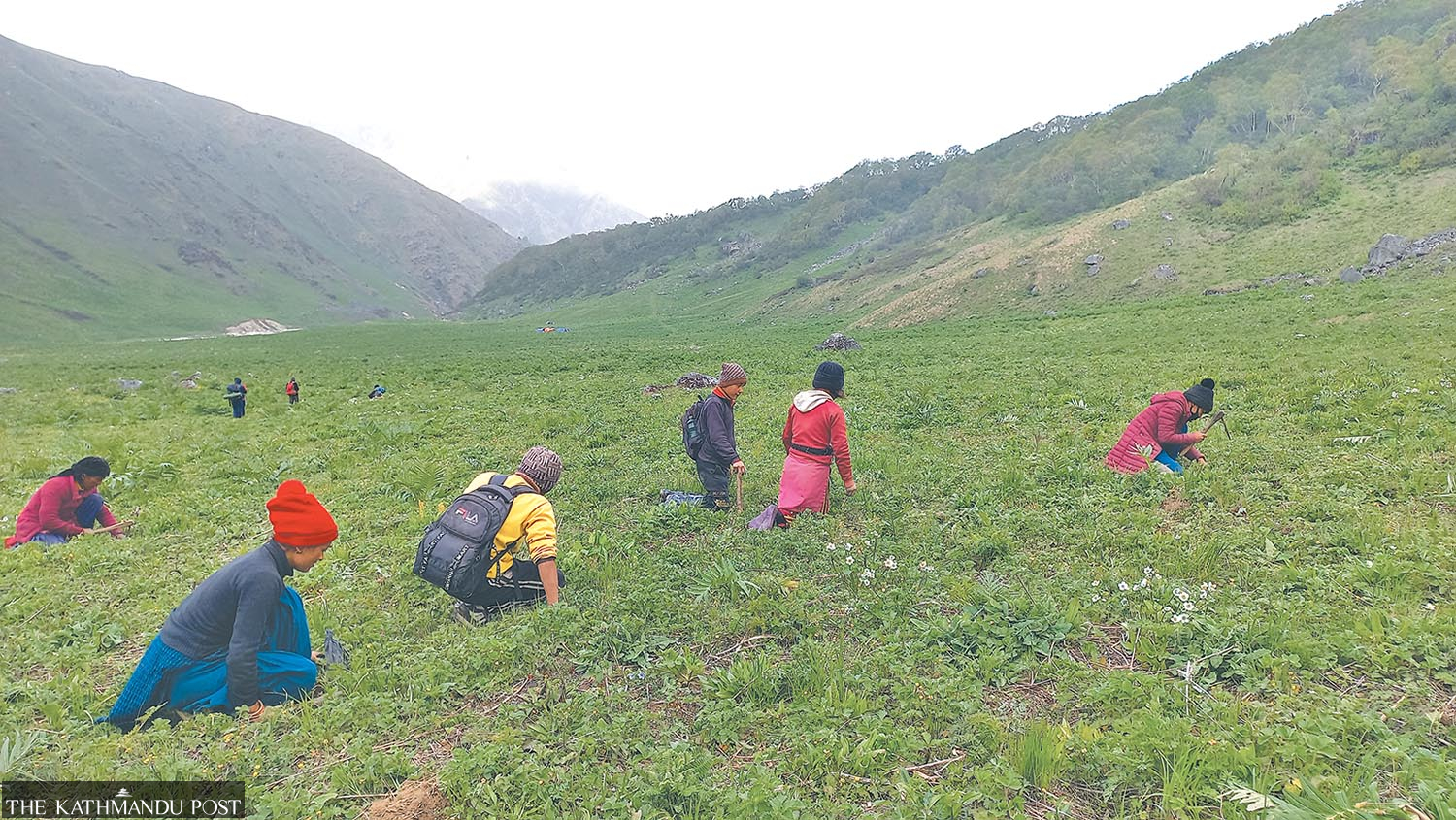
Collectors claim a comparable trend has severely impacted yarsagumba. A common local technique called "jhadu laune" entails removing vegetation and excavating the earth in pursuit of the fungal species. As they explain, this approach eliminates the subterranean larvae which eventually mature into yarsagumba.
When individuals eliminate all the grass coverage and excavate the soil, live larvae become visible," stated collector Jaya Bahadur Rokaya from ward 4 of Talkot Rural Municipality. "After the larvae emerge onto the surface, they are unable to mature into fungi.
Environmental researcher Uttam Babu Shrestha, who has extensively researched yarsagumba and herbs from the Himalayas, states that climate change has made matters worse.
Reduced and more unpredictable winter snowfall, along with increasing temperatures, has impacted the entire Himalayan environment," he stated. "Medicinal plants are naturally among the species facing these effects.
Collectors also point fingers at extensive deforestation occurring in regions where alpine herbs are cultivated. According to Devendra Dhami from Saipal, forests that previously blanketed whole hillside areas have nearly vanished within the last ten years. "Areas that used to be densely wooded are now practically empty. Yarsagumba flourished under bushes and trees, whereas herbs like satuwa can hardly endure without tree coverage," he mentioned.
A significant amount of firewood is harvested each season by gatherers and herders. According to a 2021 report from the International Centre for Integrated Mountain Development (ICIMOD), a typical group of six individuals consumes approximately 12 kilograms of firewood daily. As nearly 15,000 people visit the high-altitude pastures each year, overall firewood usage over the three-month gathering period becomes massive, contributing to deforestation and harming ecosystems home to plants like wild garlic, satuwa, atis, and various important medicinal herbs.
Seasonal grass fires have intensified the decrease. Rajendra Dhami, former chairman of Saipal Rural Municipality, stated that certain collectors intentionally burn grasslands to make yarsagumba more visible, whereas others start fires due to frustration following unproductive hunts. Discarded cigarette ends also lead to wildfires. "When a fire takes hold, it not only harms the yarsagumba environment but also wipes out all vegetation found in these high-altitude meadows," he mentioned.
The waste generated by numerous temporary gatherers has emerged as an additional major issue. Plastic wrappings, used garments, bottles, and various trash now pollute several alpine grasslands.
Medicinal plants do not thrive in areas with shattered glass, plastic, or other debris," stated Kalpana Bohara from Surma. "Even a small fragment of abandoned fabric can hinder the growth of yarsagumba.
A research project by ICIMOD carried out in Saipal revealed that over 40,000 quintals of debris have already gathered in collection zones, with the amount continuing to rise annually.
Dinesh Rokaya from Sahara Nepal, who worked together on the research, cautioned that should this pattern persist, besides yarsagumba, numerous medicinal plants found in the Himalayas might vanish from these grazing areas within just a few years.
Intensive seasonal lamb grazing is also thought to play a role in the decrease. Over 25,000 sheep from Bajhang and nearby areas feed in highland pastures during spring and summer, with temporary shelters staying up for long durations.
Botanical conservation specialist Reshu Basyal stated that the current situation can't be addressed merely by pointing fingers at buyers or dealers. "A significant number of those who collect plants lack knowledge about environmentally friendly gathering techniques," she mentioned. "The main focus needs to be on curbing unlawful picking, developing new sources of income, and encouraging responsible practices via education, rules, and teamwork."
Shambhu Tiwari, head of the Division Forest Office in Bajhang, stated that local administrations, revenue officials, forestry departments, and the private industry should collaborate to enhance preservation initiatives and guarantee the continued viability of the area's important medicinal plants.

