Chinese car manufacturers, previously regarded as "low-cost outsiders" in Europe—the origin of the automotive industry—are now transforming the marketplace. Equipped with cutting-edge technology and affordability, Chinese companies have outperformed Japanese automakers in sales for the first time in May throughout key European nations, despite significant import tariffs. With Europe speeding up its move toward environmentally friendly cars, Japanese makers—who have been slow to adopt electric vehicle technologies—have struggled, enabling Chinese brands to step in more quickly than expected.
As per the European Automobile Manufacturers' Association (ACEA), total sales of five Chinese car manufacturers — SAIC, BYD, Geely Group, Chery Automobile, and Li Auto — amounted to 138,410 vehicles across 31 key European markets during May. This represented a 12.0% presence in the market. Japanese companies came next with 130,424 units sold (11.3%), whereas South Korean makers had 80,644 units (7.5%). This represents the initial instance where Chinese brands surpassed Japanese counterparts in monthly vehicle sales in Europe, coming only slightly after domestic European brands—an impressive transformation over the past three to four years since they fully entered this region.
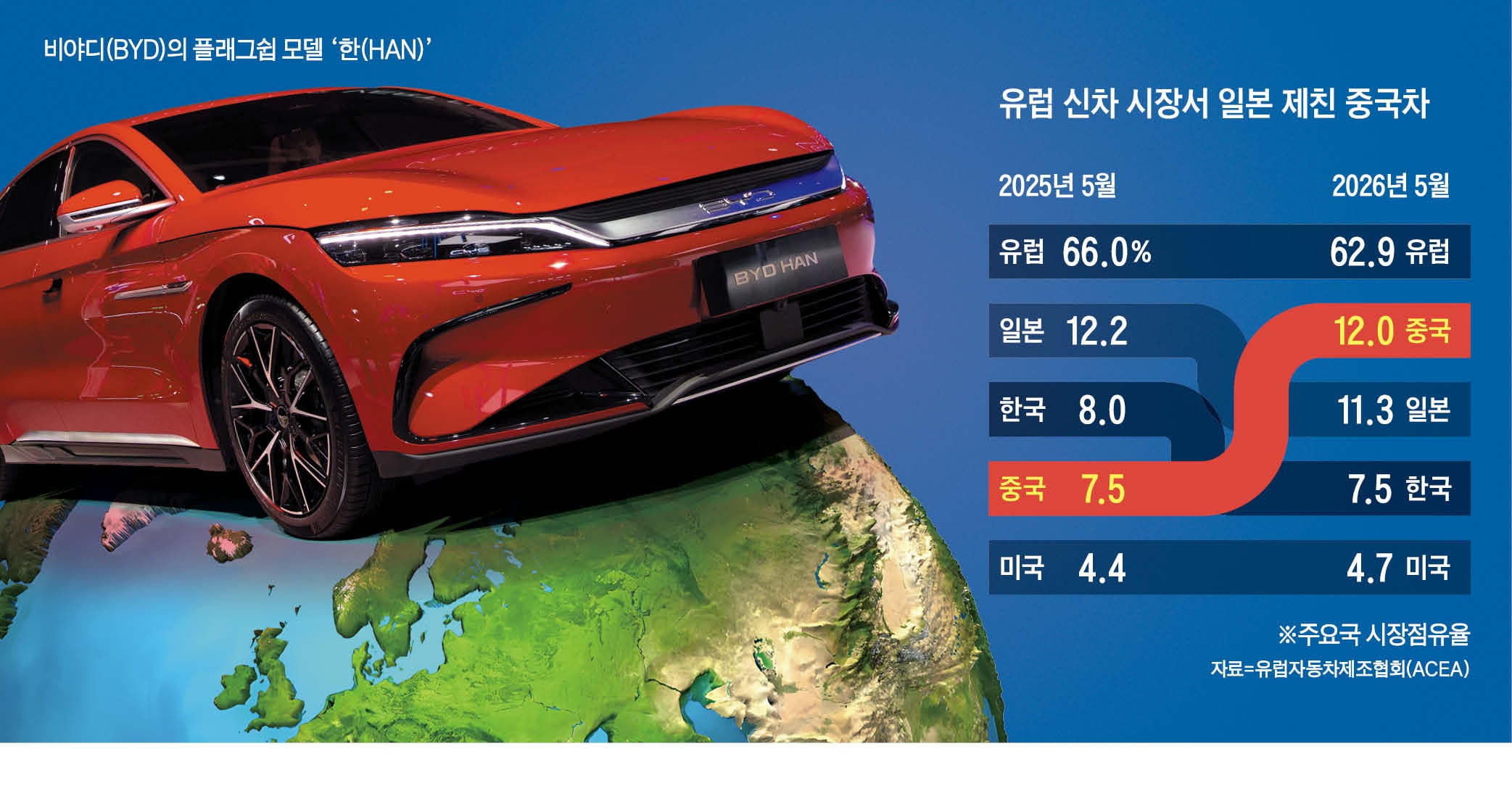
◇Chinese manufacturers surpass Japan and South Korea in the European new vehicle market
The rise in China's market presence is fueled by more Chinese car manufacturers formally launching their operations in Europe. The ACEA currently includes five Chinese brands, with Geely Group, Chery Automobile, and Li Auto joining SAIC and BYD from April onwards. Volvo, which was once listed individually, is now part of the Geely Group.
Despite considering this expansion, the growth of Chinese brands continues to be impressive. In May, Geely Group sold 38,145 vehicles, BYD sold 32,380, SAIC sold 30,527, Chery sold 27,412, and Li Auto sold 9,945. BYD and Chery achieved remarkable year-over-year increases of 136.6% and 244.1%, respectively. The success can be attributed to models like BYD's plug-in hybrid (PHEV) midsize SUV 'Seal U DM-i' and Chery's PHEV model 'Jaecoo 7', which have been referred to as the "Temu equivalent of the Range Rover" in the British market. BYD's sales volume has almost matched Hyundai's figure of 37,062 units.
◇ Competitive pricing even with tariffs as high as 45%
The emergence of Chinese automobiles aligns with Europe's elevated fuel costs and evolving financial incentive strategies. In May, sales of fully electric vehicles (EVs) across Europe hit 1,247,545 units, reflecting an increase of 31.2% compared to the previous year, whereas plug-in hybrid electric vehicles (PHEVs) saw a growth of 25.0%, reaching 594,439 units. With Germany reintroducing electric vehicle incentives and Italy broadening assistance despite economic slowdowns, Chinese car manufacturers—who excel in transitioning to electric power—gained advantages.
Even though the EU has imposed tariffs as high as 45.3% on Chinese electric vehicles, their affordability remains strong. For example, BYD's compact EV "Dolphin Surf Boost," which faces a 27% duty, sells for €26,990 in Germany but is promoted at €15,940 (about 28 million South Korean won)—under half the price of France's Renault 5 E-Tech, priced at €28,000.
The smart utilization of PHEVs, which encounter reduced duties, has proven beneficial as well. Chery's 'Jaecoo 7 PHEV', available for £35,000 in the United Kingdom, is about £4,000 (7 million South Korean won) cheaper than Kia's Sportage PHEV.
A representative from the sector stated, "Chinese car manufacturers are purchasing underperforming European plants owned by Renault and Nissan to avoid electric vehicle taxes. Rivalry against Chinese companies in international markets is expected to grow even stronger."