Technology and philosophy

Showing posts with label trauma. Show all posts

Thursday, July 30, 2026

Children of Divorce in Nepal Suffer Long-Term Emotional and Financial Strain

Kathmandu, July 2 – Khusi Gurung (name altered), a 21-year-old originating from Kaski, recently relocated to Japan several months back for advanced education. She grew up mainly with her mother’s relatives since she was two years old following her parents' separation.

She spent her childhood living with her mother's grandmother, uncles, aunts, and other close family members. When her parents divorced, she was too young to comprehend what was occurring or the reasons behind the change in her family situation.

I was two years old when my parents divorced. I don't truly recall much from that time," she stated. "As I got older, I slowly realized that they were residing apart rather than being a family unit.

Following the separation, both parents entered into new marriages. Her mother eventually relocated overseas with her new family and established herself abroad, leading to even less frequent face-to-face interactions. Her father stayed in Pokhara, and Khusi saw him from time to time, but not consistently.

She passed her Secondary Education Examination (SEE) and began attending secondary school. In her Grade 11 year, she focused on her studies during the mornings and occasionally met with friends or family in the evenings.

She mentioned that during this period, the emotional burden of her family circumstances grew more apparent and difficult to overlook.

I remember thinking about how much different my life might have been if my parents had stayed together, seeing my friends getting care from both of their parents, spending time with them, or marking birthdays as a full family," she stated. "At times, I couldn’t fall asleep at night because of these thoughts. Small remarks from people around me made me feel like I was lacking something essential.

Even though she hadn't personally experienced the split, her teenage years led to a stronger emotional understanding of what she had missed regarding family security.

Before reaching school level, I didn't pay much attention to it. However, during Grades 11 and 12, I began contemplating extensively about my parents' relationship as a family," she mentioned. "Looking back now, I understand that I was experiencing a challenging emotional period without truly grasping its depth.

Khusi mentioned that a significant portion of her emotional suffering stemmed from comparing herself to others.

My friends used to discuss how their parents bought them items, took them somewhere, or joined them at gatherings. This made me feel as though I was lacking something typical that others possessed," she mentioned. "It led to feelings of isolation, despite being around individuals who genuinely cared for me.

She mentioned that these emotions became stronger during her teenage years but have now become less severe.

Right now, I'm occupied with college and my job, so I don't experience that same degree of emotional struggle," she mentioned. "I've become more skilled at handling it as time has passed.

***

A young man residing in Kathmandu alongside his mother is facing ongoing emotional and economic challenges after his parents separated.

He mentioned that he was still quite young when his father left for another country following some borrowed money, but over time, he ceased all communication and stop offering financial help. In the end, the two separated through divorce a few years back.

"Upon my parents' divorce, there was an arrangement stating that my father would cover my educational expenses as long as I remained living with my mother," he mentioned.

Nevertheless, he mentioned that the agreement was not always adhered to. His father originally backed his studies, but ceased financial support following his remarriage.

My father ceased paying the school tuition following his second marriage," he stated. "At that point, my mother was without employment, and our financial situation turned very challenging.

He mentioned that the family had difficulty covering rental costs and educational fees during that time.

On some days, we didn’t have an idea of how we’d manage to cover the rent or tuition costs," he mentioned. "My dad used to occasionally promise he'd send money within a couple of days, yet frequently, he wouldn’t answer our calls. This conduct continues to be deeply distressing whenever I reflect upon it.

He no longer relies on his father for financial support.

My mom currently operates a small enterprise. I no longer reach out to my dad seeking funds," he stated. "Occasionally, I contact him, but solely when I want to, rather than for monetary purposes.

The teen continues to feel uneasy when thinking about his early years.

I still recall one aspect from my early years: we needed to plan specific moments simply to spend time as a family," he mentioned. "More often than not, my father wasn’t available. Reflecting on this even today brings me pain.

These stories reflect just a minor part of the real-life situations faced by children impacted by their parents' divorce in Nepal, as specialists point out that the emotional and societal effects are common yet rarely addressed.

As per information provided by the Supreme Court of Nepal, 40,320 legal matters were submitted in different courts during the financial year 2023-24. Out of these, 31,752 were settled.

During the financial year 2024-25, 42,739 cases related to divorce were recorded, of which 33,050 had been resolved.

As of mid-June in the ongoing financial year, 42,703 cases were submitted, with 29,131 resolved so far.

***

Psychologists indicate that when parents separate, it can lead to considerable mental and social impacts on kids, which vary based on their age, surroundings, and how involved each parent remains after the divorce.

Child and adolescent psychiatrist Dr. Amit Jha stated that divorce has a direct impact on a child's overall growth.

"In terms of a child's comprehensive growth, both the mother and father have vital and supportive roles. Typically, mothers are seen as providing emotional care, whereas fathers are usually connected with offering practical advice and teaching about outcomes," he stated.

Upon separation, this harmonious approach to child-rearing is disturbed, leaving children frequently feeling the absence of an essential source of stability.

He mentioned that the effect differs considerably across different age groups.

Younger kids usually lack a solid grasp of ideas like separation or passing away. They find it hard to understand why parents who used to live together are now apart," he mentioned. "When they reach teenage years, they start measuring their situations against those around them. Observing stable families may cause them to feel less worthy, experience emotional turmoil, and become confused."

He mentioned that this kind of emotional pressure may lead to diagnosable medical disorders.

"It may manifest as an adjustment disorder, with kids feeling sad, having a poor mood, becoming easily annoyed, and showing emotional unpredictability. In several respects, this is similar to mourning after losing someone," he stated.

Persistent stress, when not adequately addressed, may progress to more severe issues like depression, anxiety disorders, and occasionally, drug misuse. Certain kids might also become overly reliant on electronic gadgets, resulting in an overuse of screens as a way to deal with their emotions.

He emphasized that maintaining shared parenting duties following a divorce is crucial for minimizing damage.

Divorce represents a legal split, but it doesn’t mark the conclusion of parenting duties," he stated. "After the divorce, both parents remain responsible for the emotional and physical care of their children.

He mentioned that the custodial parent should also strive to maintain an equitable distribution of responsibilities.

the parent who has custody of the child should strive to offer both emotional and tangible assistance," he stated. "children must avoid being subjected to unfavorable comments regarding the other parent.

He further emphasized the significance of comprehensive familial support networks.

He stated, 'Grandparents, uncles, aunts, and extended family members can significantly help alleviate feelings of isolation and offer emotional support.'

Timely action is essential once initial indicators emerge.

Immediately seek professional counseling if a child exhibits ongoing sadness, isolation, behavioral changes, sleeping problems, or reduced food intake," he stated. "Caregivers must also take care of their own psychological well-being as well.

Laxman Prasad Sharma, a lecturer at Tribhuvan University, mentioned that broken families lead to lasting instability for kids.

Without strong emotional connections and a nurturing atmosphere, a child's growth and education may suffer considerably," he stated. "This prompts important concerns regarding the type of society we are building for tomorrow.

***

According to Articles 114 and 115 of the National Civil Code from 2017, decisions regarding custody and upbringing following a divorce take into account the child’s age and what is considered most beneficial for them.

"During decisions regarding custody in divorce proceedings, courts focus on the child's best interests," said advocate Bhabesh Gautam to Kantipur.

A minor below the age of five is typically placed with the mother, irrespective of her marital status," he stated. "Children aged between five and ten may either be entrusted to the mother’s care, with the father obligated to cover financial responsibilities, or alternatively, custody could be awarded to the father.

According to Adhikari, for children older than ten years, the child's own preferences are considered when deciding on custody.

In reality, access privileges are frequently challenging to implement even with established laws.

Even though the law permits visits anytime, enforcement within Nepalese society varies greatly," he stated. "Within wealthier households, kids are occasionally sent overseas, which can make maintaining relationships with the other parent challenging. In middle-class homes, children frequently face an absence of their father following a separation.

"Divorce is relatively uncommon among low-income families unless the woman marries again, resulting in fewer instances of children being separated," he stated.

Child welfare officer Gita KC Darnal mentioned that kids frequently find it difficult to cope with their parents' divorce, especially when one parent remarrys.

She stated, 'Children have great difficulty accepting separation.' 'When parents get married again, the emotional effect on kids usually becomes stronger. Although they may seem to accept it from the outside, many face internal challenges in adapting to new family setups.'

She emphasized that balanced emotional assistance from both parents is crucial.

She stated, 'When kids don't get equal affection and support from both parents, their psychological well-being suffers because they experience less consistency and safety.'

"Following a divorce, numerous children face emotional difficulties. Some might acquire mental health issues, whereas others could be drawn into hazardous activities or drug consumption," she stated.

She mentioned that sensations of isolation are common among children who have been impacted.

Many kids grow up envisioning a unified family," she stated. "Despite efforts from parents to stay connected following a split, children may still experience emotional loneliness as each parent starts forming their own distinct life.

Thursday, June 18, 2026

Burying My Daughter and Husband in One Day: 3 Years Later, I Saw a Man With His Disability

I sensed something was deeply wrong when a policeman arrived at my house just after midnight. He acted unusually kind, speaking in a soft, hoarse murmur as he informed me of the tractor trailer, the black ice, and the subsequent blaze. "Mrs. Bakari, there was significant heat damage. An open coffin is... strongly not recommended."

Sorrow does not merely hurt someone; it empties them, stripping away all that is gentle and humane until only an empty frame remains—a lifeless figure wandering through a realm of dull, unchanging noise.

For three years, I existed within that empty form.

My flat in Komarock was a lesson in total emptiness. Blank walls. A lone, typical mattress placed right on the wooden floor. One seat. One cup. No pictures. No vibrant carpets to hint that the outside world had colors.

If you have no affection for anything, nothing can be stolen from you. This was the belief system I followed in the cold, silent solitude of Room 3C.

Each day, I rose at 5:00 AM, well before daylight arrived. I'd rest on the edge of my bed, gazing at the empty wall, focusing on the sound of my breathing. This was the sole evidence I possessed that I hadn’t perished alongside them during that awful, wet November period.

I am Fatuma Bakari, and three years ago, my life did not simply come to an end; it was completely erased.

I can still recall the overwhelming aroma of the white lilies that filled the funeral home. It was a joint ceremony, but they were not placed next to each other. My husband, Mohammed Bakari, lay in a smooth, shiny mahogany coffin. A closed coffin.

"The incident involved an accident," the policeman who had come to my door stated, employing clinical, medical terms meant to protect a pregnant woman from envisioning her husband as he was consumed in flames within a crumpled mass of metal.

I remember screaming.

I remember crying.

I recall falling down onto the front steps.

No further events seemed genuine.

From that point onward, Mohammed's mother, Zainab, took full authority. I was too stunned and devastated to challenge her on anything.

Zainab was a woman shaped from icy stone, a powerful leader who carried her sorrow as unyielding protection. She demanded a quick, confidential ceremony. She managed the funeral home, official documents, and arrangements.

we should keep remembering him as he was, fatuma," she whispered in my ear, her hands gripping my shoulder with the force of claws. "don’t look. don’t tell the director to open it. spare yourself from this torment.

I had fallen asleep without thinking, holding onto my enlarged stomach. I was seven months along with our daughter, Zuri. She was our wonder, the child we had longed for over four painful years, going through unsuccessful cycles of IVF and having sorrowful talks at night.

However, the human body has limits regarding how much damage it can endure before reacting against itself.

At the funeral ceremony, as the minister talked about unexpected losses and meeting again in heaven, a searing, intense wave of pain shot through my lower stomach.

I recall the chill of perspiration spreading over my brow.

I recall glancing down and witnessing a dark, horrifying mark expanding over my flower-patterned pregnancy dress.

Zainab didn't shed any tears. She simply called for an ambulance.

For the following 24 hours, I remained confined to a hospital room, caught in an awful state between intense contractions and deep sorrow.

The medical team did all they could, their expressions showing intense concentration, yet the pressure led to a severe placenta previa.

As my husband's body was being placed into the chilly, moist soil, I was crying out into a hospital pillow, delivering a quiet, flawless, lifeless baby girl.

I laid Mohammed to rest on a Wednesday. I interred Zuri on a Thursday.

The graveyard remained unchanged, yet the graves were distinct. Zainab had demanded that Mohammed be laid to rest in the Bakari family burial ground.

Zuri, who came into the world without an official name or a sign of vitality, was buried in a secluded, dimly lit part of the nursery for infants, beneath a modest stone plaque that I could scarcely afford.

The following days were filled with complete devastation. I had anticipated mourning within our lovely, suburban Craftsman house, among Mohammed's sweaters and the partially painted nursery. However, I found myself facing an intense, disorderly flood of real life instead.

Just 48 hours after the funerals, my phone started ringing. It wasn’t with expressions of sympathy, but rather with requests.

Mrs. Bakari? This is Surreal Asset Recovery. We have to arrange the retrieval of the Mercedes.

Ms. Bakari? This is the billing office at Divine Memorial Hospital. There is a pending payment of thirty thousand shillings.

Fatuma, this is Mr. Henry from the bank. We need to talk about the second mortgage on your home. The payments have been four months late.

I felt overwhelmed. I recall being on the floor of the baby’s room, clutching a small orange onesie, as a person in a reflective vest approached our drive to attach Mohammed's vehicle to a towing truck.

I found out that our bank accounts had been entirely emptied. The money we saved specifically for Zuri's education? It was gone. Our shared checking account? Deep in debt, with thousands missing.

Each envelope that came through the mailbox had an assertive red stamp. Past Due . Notice of Default . Intent to Foreclose .

I recall being seated beneath the bright lights of the kitchen counter, gazing at rows of financial data related to company debts, salary advances, and over-limit credit cards that had previously escaped my notice.

Muhammad had methodically weakened our financial base while dining with us each evening.

When I rang Zainab, feeling hopeless and crying, she ignored me. "Mohammed was never good at managing finances, Fatuma. You were aware of that. I can't afford to help you fix his mistakes. Put the house up for sale. Begin again!"

Therefore, I sold all of my possessions. The home was put up for a short sale to prevent being taken through foreclosure. The furnishings were sold at low prices to aggressive liquidation companies. I packed just one suitcase, took the small amount of money left from my personal pre-marital savings, and got on a bus heading to Mombasa.

I selected a city where I was unknown. I picked a building occupied by temporary tech employees and silent senior citizens who kept to themselves. I secured an unthinking, distant data-input position that demanded no personal engagement.

For three years, my daily schedule served as my protection. Get up. Turn on the computer. Input countless rows of senseless digits into a spreadsheet. Sign out. Have a bowl of simple rice or regular chicken soup. Go to sleep.

I believed I had effectively ended the life of the woman I once was. I thought Fatuma Bakari was just as deceased as the husband and daughter she had laid to rest in the rainfall.

I was wrong.

It occurred on a Monday during the first week of May.

My neighbor's apartment, Unit 3D, had remained empty for two months. I preferred it like that. It meant fewer walls in common, fewer sources of background sounds disrupting my meticulously planned isolation from external stimuli.

However, around midday, the loud, reverberating sounds of moving boxes started shaking the floorboards. I didn’t check through the peephole. It didn’t matter to me. Families arrived and left in this city like the ocean waves.

As night fell, the sounds faded into the usual household patterns of a young family. I could pick up the soft, muted echo of a child’s excited giggles, then the steady, thudding steps of someone moving around on the wooden flooring. A woman's cheerful, musical voice came through the weak wall, humming a lullaby.

The noises caused my stomach to churn with a sour, recognizable pain. This was the existence I was meant to live. I shut my eyes, hugging my legs close to my body as I lay on the mat on the floor, anticipating the return of quiet.

The following day at approximately 4:00 PM, I had to dispose of my garbage. It was a simple practical errand, yet it involved exiting onto the corridor and walking toward the shared disposal bin close to the elevator.

I opened my door while carrying a tiny, transparent plastic bag filled with trash and crossed the doorway. Just then, the entrance to Unit 3D creaked open.

A man emerged into the corridor. He had a young child, about two years old, with vibrant golden hair. The toddler was laughing, her tiny fingers clasped around his neck.

The man chuckled, producing a rich, echoing noise that seemed to skip past my ears and hit me right at the core of my back.

My shoes became frozen to the rug. The garbage bag slid out of my hands, landing on the ground with a gentle, rustling sound.

The individual looked in the direction of the noise.

The corridor lighting in our building had a bright, fluorescent yellow hue, yet it revealed every bit of his facial structure. The distinct, curved nose. The subtle, recognizable indentation along his strong chin. The manner in which his dark, full brows consistently angled downwards, conveying an air of constant, deep concentration.

It was Mohammed.

You're going crazy You're losing your sanity You're becoming unhinged Your mental state is deteriorating You're slipping into madness You're not thinking clearly anymore You're descending into insanity Your grip on reality is fading You're starting to lose control of your thoughts You're heading towards a breakdown the logical portion of my mind cried out, It's a grief-induced hallucination . You have remained cut off for way too long .

"Oops, I'm sorry! I didn't intend to scare you," the man remarked.

The voice—it was more than just recognizable. It carried that distinct, relaxed manner of elongating his vowels. A faint whistling sound on the letter "S," a remnant from a childhood dental appliance.

I was unable to talk. My jaws wouldn't budge. I gazed at him, my eyes large and fixed without blinking. The man glanced back at me, his grin waning a bit beneath the force of my wild gaze.

I then examined his left hand. Similar to Mohammed, both his index and middle fingers were completely absent. This was an old wound resulting from a childhood mishap involving a circular saw. A distinctive physical characteristic, one so unusual that it had been the subject of my teasing whenever we clasped hands in the darkness of a movie theater.

"Mohammed?" I said.

The man's whole body became stiff. His friendly, neighborhood grin disappeared immediately, followed by an abrupt whiteness that matched my own.

He didn't look confused.

He did not appear to be someone mistakenly recognized.

He appeared as though he had just been discovered.

"I... I believe you're confusing me with another person," he responded.

He did not linger for my response. He opened his door and returned into his home. I remained alone in the corridor, with my dropped garbage bag leaning beside my feet.

The world no longer made sense. I possessed the man's death certificate stored inside a metal container beneath my bed. I witnessed his coffin being lowered into a grave. I cried for many days due to the sorrow of losing the man who had vowed to love me till death ended our union.

He had only recently entered to eat dinner with a different woman's child.

That night, I couldn't sleep at all. I didn't even sit down. How? How can a deceased person be walking around? How could someone turn into ashes after a car accident, only to show up again in my home three years later with a child?

The fragments of history started to move, rearranging into an entirely different design. I reflected on the sealed coffin, Zainab's firm demand that I not open it. The hurried setup she had arranged.

I considered the loan. The private creditors. The intimidating telephone calls. The emptied banking accounts. Mohammad wasn't particularly bad at investing. He was struggling.

The following day, I rang Mohammed's doorbell as soon as his wife had departed. "Let me in, or I'll contact the building supervisor and the police at once."

The entrance creaked open about six inches, secured by a thick safety chain. Mohammed peered at me through the gap.

Fatuma," he murmured. "Please, don't go through with this here. My wife... my daughter... they have no idea.

"Am I your wife? I possess both the marriage and death documents. Which one should I present to the neighbors first?" I yelled.

He quickly unlocked the chain and moved aside, keeping the door wide open. "Please come in."

"What are you doing here?" I questioned, turning to look at him.

I had gone too far, Fatuma," he cried. "You have no idea who I owed money to. It wasn’t only the banks. I messed up. With bad business associates. They warned me they would target the house...they would go after you.

Did you fake your own demise?

I deliberately crashed into a traffic post, and the vehicle ignited. I viewed this as a chance. If people believed I was inside that car, the loan would perish along with me. The danger would cease.

"And Zainab?"

That evening, I called my mom using a public phone. She discovered my wallet close to the location prior to the police completely securing the area. She took care of everything else. She requested a sealed coffin and assisted me in withdrawing money from my secret accounts before the bank put a hold on them.

Did you leave me to handle all of this by myself?

I believed the life insurance would protect you," he shouted. "The half-million payment was meant to assist you in taking care of yourself and the baby.

The insurance firm considered the accident questionable because your remains could not be identified. They delayed the payment for two years. I didn’t receive even one cent.

But my mom said you were being looked after. She mentioned you had left to begin anew.

Zainab was dishonest. Because of the stress, I also lost our child.

Really? I had no idea. However, I now have another family. My daughter, Rukia, is two years old. She requires a father. My wife, Aisha, isn't aware of my history. If you reveal the truth, it will destroy them.

"I can't let you hide behind a child for your actions," I stated, then turned and left the apartment.

I returned to my home and contacted the authorities. Over the following hour, I shared every detail. The location. The names of his mother, Zainab Ali. The information regarding the bank accounts that were erased shortly before the incident. I informed them about the absence of fingers on his left hand.

Then, I contacted the insurance company. Less than half an hour later, a fraud investigator was recording my account. By the end of the afternoon, the corridor on the third floor had transformed into the setting for the last scene of my previous life.

I observed as four law enforcement officials pulled him from the apartment while he was cuffed. "Mike Makori, also referred to as Mohammed Bakari, you are being arrested for fraud, identity theft, and conspiracy..." stated the senior investigator.

Muhammad's shocked new wife exited the apartment approximately one hour following the arrest, taking two big suitcases along with their daughter.

The next day, Zainab was taken into custody at her residence in Umoja as an accomplice in the scam and for submitting a false death certificate. Local news coverage in the crime section was minimal: A Mother and Her Son Charged in a Fraudulent Life Insurance Scheme Involving a Three-Year-Old Child .

Six months have passed since that day in the corridor. Even though exposing Mohammed did not return my daughter to me or change the course of my painful, solitary sorrow, it lifted the oppressive weight of being a victim from my shoulders.

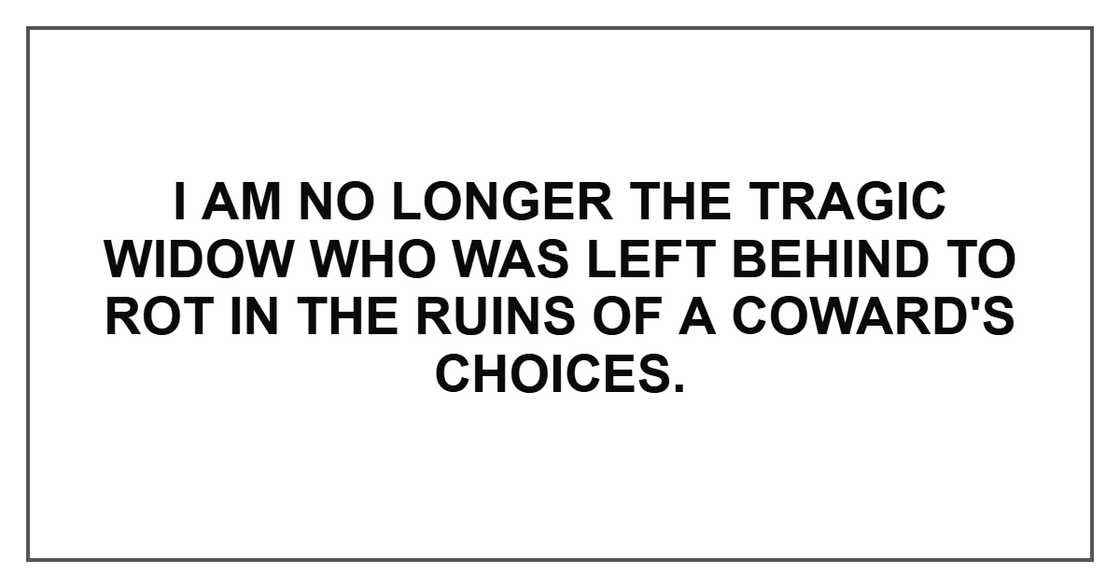
No longer the sorrowful wife abandoned to decay among the remnants of a weak man's decisions, I am Fatuma. I am living. And for the first time in a long time, I find myself eager for what lies ahead.

Therefore, I wonder: which hurts more—losing a loved one due to death, or realizing they decided to remove you from their life?

This narrative draws from the genuine encounters shared by our audience. We feel that each tale holds an insight capable of illuminating someone else's path. In order to safeguard all individuals' confidentiality, our team might alter names, places, and specific elements while maintaining the essence of the story intact. The photographs are solely for visual purposes. Should you wish to present your personal account, kindly reach out to us through electronic mail.