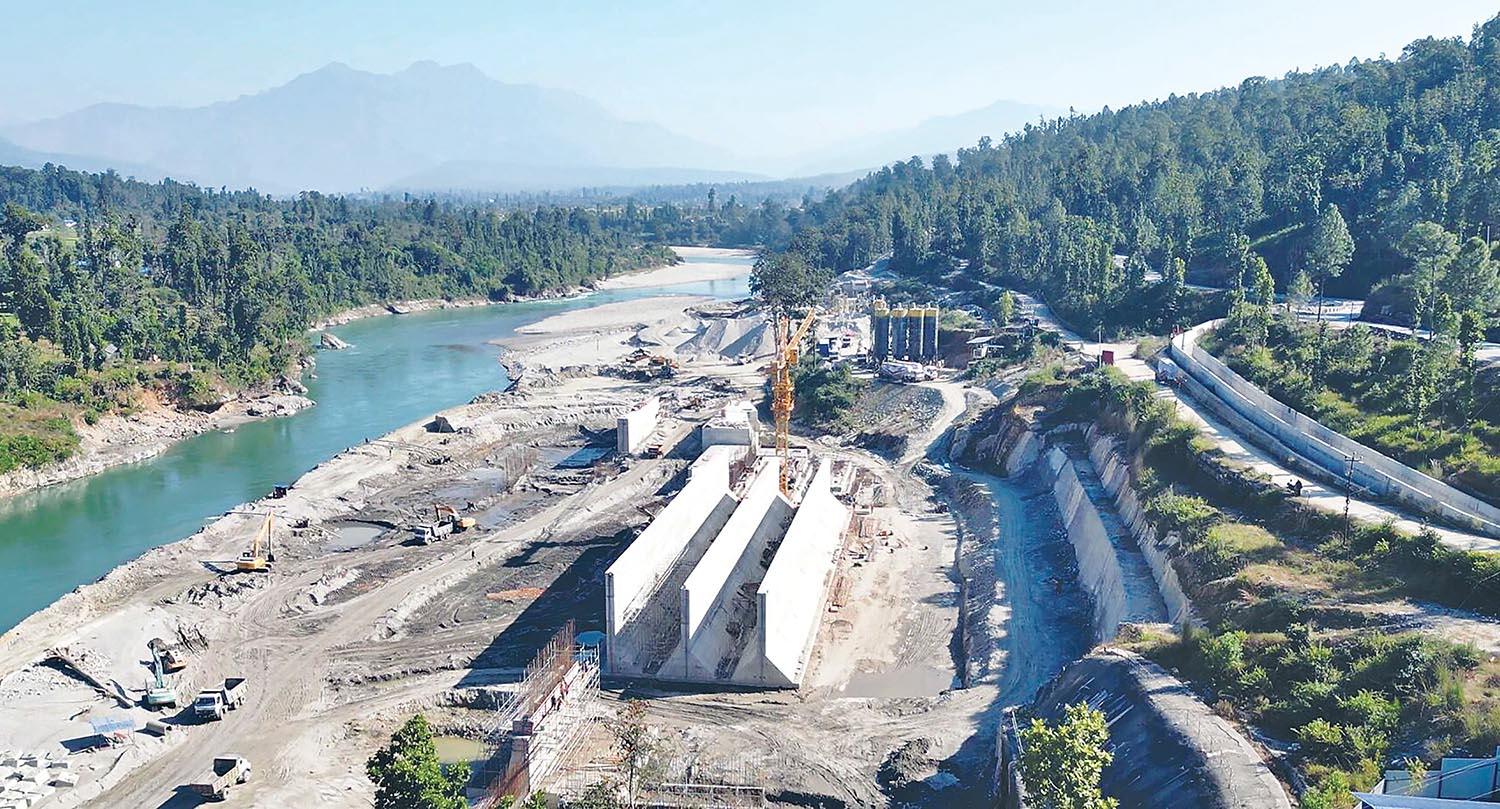
Kathmandu, July 2 – A newly introduced Water Resources Act aims to reform Nepal’s laws concerning water management, bringing them into line with the nation's federal system. The bill outlines the responsibilities of national, regional, and municipal authorities, along with more rigorous rules regarding water utilization, ecological conservation, and the security of dams.
The proposed law addresses various aspects including the allocation of power in irrigation and energy development, usage of water resources, safety of dams, and tracking of water consumption.
After being passed into law, it will supersede the three-decade-old Water Resources Act from 1992, and create more defined lines of authority along with improved systems for sharing income across the three levels of government.
The legislation also aims to provide legal acknowledgment for the Water and Energy Commission, which has previously functioned based on a government establishment directive.
Some of the main elements of the legislation establish a framework for water tracking, requiring officials to keep detailed logs of available and used water. Additionally, it calls for thorough evaluations of all water supplies, such as those from rivers, aquifers, rainfall, and other origins.
The suggested legislation further mandates that officials consider water set aside for religious, cultural, and environmental purposes, in addition to provisions for potable water, farming, hydroelectric power production, and various other applications.
Prakash Chandra Dulal, the vice-chairperson of the Independent Power Producers' Association Nepal (IPPAN), stated that various clauses weaken the essence of federalism by maintaining major decision-making authority within the central government.
"The Constitution created three levels of governance, yet needing permission from the commission essentially maintains centralized control over decisions," Dulal stated.
The legislation further enhances ecological protections for waterway-related development initiatives.
Developers building structures on rivers and streams are required to ensure consistent environmental flows below their projects all through the year. They have to discharge no less than 15% of a river’s lowest flow—or the level suggested by an environmental impact study, depending on which is greater—beneath the dam. The term "environmental flow" means the smallest volume of water that needs to remain flowing downstream to support the river's ecological system as well as those relying on it.
The current Water Resources Act mandates that users must employ water in a manner that does not negatively impact others. In contrast, the Hydropower Development Policy from 2001 obliges project developers to discharge at least 10 percent of a river’s lowest monthly average flow, or the quantity determined through an environmental impact study.
As per Dulal, raising the minimum distribution rate from 10 percent to 15 percent might considerably lower power production from private hydroelectric initiatives.
The legislation mandates that either 15 percent of the minimum flow rate be maintained or the quantity suggested by the ecological assessment, depending on which is greater. This will lower the power output from our initiatives," he stated. "It will notably impact those projects that were developed within the current regulatory system.
The suggested law also establishes an extensive system for categorizing dams, ensuring their security and safety.
It allows the government, following advice from the Water and Energy Commission, to categorise dams depending on their storage ability, construction type, engineering plan, and use.
According to the proposed legislation, the government will take charge of ensuring dam safety. Operators of dams can ask the government to offer security measures for their facilities. Nevertheless, if this assistance is granted, the operators will be required to cover all associated expenses. Additionally, the government has been empowered to set nationwide guidelines for dam security.
Dulal stated that the clauses are still unclear.
The legislation states that the government will offer dam protection solely upon the request of the operators, yet it fails to clarify what occurs if the government denies such a request," he stated. "Meanwhile, should the government agree to provide security, the operator must cover all associated expenses. This leads to doubts regarding the rationale for seeking governmental assistance in the initial place.
The legislation also mandates that dam managers perform thorough safety evaluations every five years using a separate group of specialists, based on how each dam is categorized.
Energy Minister Biraj Bhakta Shrestha stated that the highly anticipated law explicitly outlines the rights, obligations, and roles of national, regional, and municipal authorities as per Nepal's federal system.
He stated that the suggested legislation focuses on the preservation, environmentally responsible growth, and versatile use of water sources, while encouraging fairness across generations and minimizing water-based catastrophes.
"Our commitment is to make water resources the foundation of the nation's prosperity through the effective implementation of this law," Shrestha wrote on social media. "Only through the proper utilisation, conservation and management of water resources can sustainable development be achieved."
The legislation officially integrates the Water and Energy Commission into legal framework. The commission was set up by the government in 1975 with the aim of advancing the coordinated development, administration, and use of the nation's water and energy resources, yet it has always lacked formal recognition under statute.
Dulal opposed the suggested management framework, stating that it bars regional and municipal authorities from participating in the commission's decision-making process, thus conflicting with Nepal's federal structure.
"The suggested legislation is not entirely national nor favorable to the private sector since provincial and municipal authorities have been left out of the commission's management," he stated.
The current Water Resources Act bans the utilization of water sources without acquiring a license, with exceptions including personal consumption of drinking water, watering one’s own farm, running conventional watermills, local boating transport, and restricted usage of water resources found on privately owned land.
The suggested law also outlines a clear allocation of duties across the three levels of governance.
According to the legislation, the central government will manage irrigation initiatives spanning over 200 hectares in the Himalayan and hilly areas, as well as more than 5,000 hectares in the Tarai, Madhesh, and Inner Madhesh zones. Additionally, it will handle land stabilization efforts surpassing 5,000 square meters and river management or flood prevention activities stretching further than 10 kilometers.
Local governments would be responsible for irrigation initiatives affecting as much as 200 hectares in hilly and mountainous regions and up to 5,000 hectares in the Tarai area. They would also manage deep tube well installations, pump-based irrigation schemes, developments crossing multiple municipalities within a single region, landslide mitigation efforts ranging from 1,000 to 5,000 square meters, and river management projects stretching up to 10 kilometers.
Municipal authorities will oversee irrigation schemes utilizing shallow tube wells and land subsidence control initiatives spanning under 1,000 square meters.
In the energy industry, the national government will oversee power production initiatives that span two or more provinces, activities not under provincial or municipal authority, and the exchange of electrical power.
Provincial authorities will be responsible for monitoring hydroelectric power initiatives with an installed capacity exceeding 5 megawatts but not surpassing 25 megawatts, along with projects under 5 megawatts that span multiple municipal jurisdictions.
Municipal authorities will hold control over power generation initiatives having a maximum capacity of 5 megawatts.

