Technology and philosophy

Showing posts with label immigration. Show all posts

Wednesday, July 15, 2026

Where Did Kenya’s Diaspora Money Come From? (2024–2025)

The U.S. continues to be the main source of diaspora-related money transfers to Kenya, surpassing every other international contributor significantly.

Data jointly released by the Central Bank of Kenya and the Kenya National Bureau of Statistics for the 2024–2025 fiscal year shows that the North American country injected more than Sh400 billion into the national economy.

This large influx highlights the economic power of the Kenyan population living in the United States and their ongoing financial support for their homeland.

After the United States, Germany ranks as the second-biggest origin of remittances from abroad.

Australia is also highly visible among the leading routes for money transfers, sending nearly Sh90 billion. These numbers show that conventional Western economies still account for the biggest portion of Kenya's foreign financial assistance provided by its diaspora.

The primary sources of remittances include the Middle East along with certain areas in Europe and Africa, albeit with smaller amounts. Saudi Arabia and Qatar each provided approximately 45 billion shillings, reinforcing the Gulf area's position as an essential center for jobs and finance for Kenyan workers.

In Europe, Spain contributed almost Sh35 billion. In Africa, South Sudan became a major source of funds, generating slightly less than 35 billion shillings, which was very close to the amount received from the United Kingdom.

Supplied by SyndiGate Media Inc. ( Syndigate.info ).

Sunday, July 12, 2026

How the Entry-Exit System Is Haunting Europe’s Summer Travelers

A ghost is lingering over Europe, or at least its outer boundaries—the Entry/Exit System (EES), an automatic tool designed to track foreigners coming into and departing from the Schengen Zone, potentially disrupting the vacation period for countless travelers.

The European Entry System is slowly moving away from traditional passport stamps, implementing a digital process that tracks travelers' entry and departure times within the Schengen Zone for brief visits. This new approach gathers biometric details like face scans and handprints, alongside personal information obtained from travel papers.

It has been implemented across all external boundaries of the 29 nations within the visa-free zone, which includes all European Union member states excluding Cyprus and Ireland, along with Switzerland, Liechtenstein, Iceland, and Norway.

To whom does it apply?

The policy covers individuals from outside the EU/Visa-free zone who are visiting Schengen or European Union nations for brief visits.

A "brief visit" refers to a duration of up to 90 days within an 180-day timeframe, intended for leisure travel, professional visits, or familial gatherings. Non-residents are required to obtain a "short-term" visa prior to entering Europe and must not surpass the authorized length of their stay upon arrival.

Individuals traveling from specific nations, including the United States, United Kingdom, Australia, or various Latin American countries, do not need a visa; however, they must comply with the EES system.

Residents of the EU and Schengen area countries do not undergo these inspections, along with citizens of Andorra, San Marino, Vatican City, and Monaco.

Additional exemptions apply to non-citizens holding long-term visas or residency documents issued by a Schengen nation, as well as airline and railway staff traveling internationally, and military personnel.

What is the reason for establishing the EES?

The EES aims to speed up and enhance the efficiency of border controls, simultaneously strengthening security through providing border officials and national agencies with travelers' data, enabling them to identify threats linked to international crime and terrorism.

A primary objective is to hinder unauthorized immigration. The EES monitors arrivals and departures by capturing biometric information such as fingerprints and face recognition details into an electronic system, aiming to stop individuals from remaining beyond their authorized stay in a Schengen area nation or employing false identification.

According to the European Commission, over 40,000 individuals have been denied access since the implementation of the policy, with causes including outdated or fake documentation, or failing to adequately explain the purpose of their trip.

Over 1,000 individuals have additionally been recognized as presenting threats to Europe's safety.

What's the problem?

The EES started functioning completely on 10 April 2026, after a step-by-step introduction that commenced on 12 October 2025. The deployment has taken place gradually over six months, once every Schengen country submitted its "statement of preparedness" for adopting the system. Nevertheless, the process hasn't been entirely smooth.

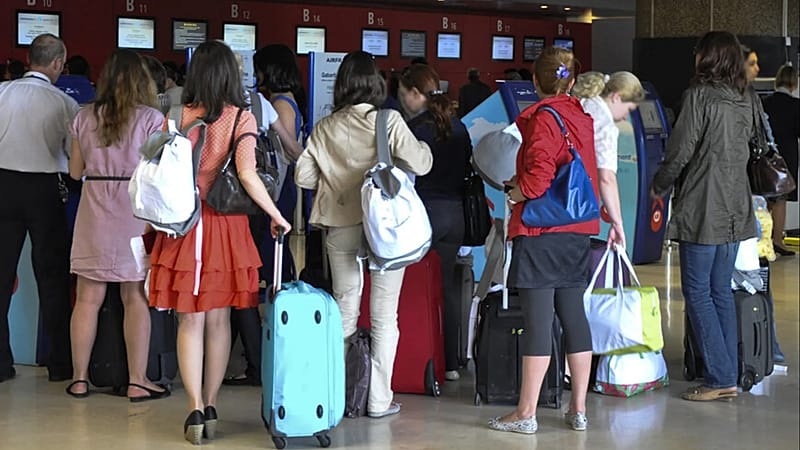
The EES operates at land, sea, and air borders, yet its execution is causing delays and congestion primarily at airport terminals, resulting in extended lines and intricate processes.

Airports and airlines are facing operational challenges, resulting in delayed flights and lost connections, affecting not only Europe's biggest hubs but also smaller airports that cater to popular tourist areas, since certain terminals lack sufficient functionality, such as adequate staffing for customs, proper facilities, and automatic border control systems.

As a result, multiple partially empty flights remain at the gates when they close, with travelers still waiting in line for border checks. The wait times at immigration have risen sharply, occasionally extending up to five hours during busy travel seasons, affecting millions of passengers.

According to a letter submitted to the European Commission by groups representing airlines and airports, the current state has "become critically urgent."

The European Airlines Association, ACI Europe, and the International Air Transport Association called for "urgent action" and sought leniency to fully halt the EES system during July and August "if passenger numbers surpass the capabilities of border control infrastructure."

Over the next two months, with the holiday period reaching its height, European airports are projected to manage around 40 million additional travelers compared to the numbers seen in May and June.

Uku Särekanno, an assistant head of the European Union border authority Frontex, said that conditions will become stable within one or two years, since obtaining fingerprints from travelers outside the EU during their initial arrival at the Schengen Zone is "likely the hardest aspect" of implementation.

What actions is the Commission taking?

As per the regulations, countries within the Schengen area have some limited temporary permission to stop collecting biometric information when their immigration officials face challenges managing the number of travelers.

Nevertheless, no additional exceptions are permitted.

Greece considered Halting the gathering of biometric information from UK travelers because of strain on its tiny island airports throughout the festive period, although the European Commission stated that pausing the system is allowed solely during times of heavy traveler flow at particular border crossings and does not extend to any nationality group.

In response to feedback from the aviation industry, a representative of the European Commission stated that every possible action is underway to minimize effects on passengers across the EU, asserting that in the majority of EU airports, the consequences remain minimal.

"The Commission has been strongly assisting member countries and the air transport sector in adopting the new system, and we will maintain and enhance our assistance when necessary," the representative stated.

The Commission has requested an "emergency session" with government officials and aviation sector representatives, scheduled for the near future.

Sunday, June 21, 2026

Faith Leaders Intervene to Stop Xenophobic Attacks in George

Anti-immigrant demonstrations have already resulted in fatalities along the Garden Route.

Last month in Mossel Bay, many homes were set ablaze and two individuals lost their lives in an incident involving... violent xenophobic protest .

Protests in the same area have led to hundreds of migrants being affected. repatriate to Malawi and Mozambique.

Near the Garden Route city of George, located 50 kilometers from Mossel Bay, local officials worry about increasing hostility toward immigrants and fear that violent incidents may soon occur.

During Sunday night, hundreds of individuals participated in an event hosted by an organization named Qina Mhlali (strong residents) at the All Bricks community center located in Thembalethu, a neighborhood near George. The venue was filled to capacity, with many others standing outside.

During the days before the gathering, a post was shared online. Mabahambe "Go away!" the sign stated.

As a reply, the Thembalethu Pastor's Fraternal issued an open letter urging for composure and condemning aggression. "Today the Lord places a responsibility upon us: to speak and take action against xenophobia in our neighborhoods," stated the open letter.

On Friday, the chairman of the organisation, Pastor Boyce Saleni, convened a gathering with the event coordinators and Mayor Browen Johnson from George, along with representatives from the business association and the South African National Civic Organisation (SANCO).

The decision was made to invite Home Affairs Minister Leon Schreiber to visit George later this month to speak about the community's issues.

Unemployment is high in the Southern Cape, and residents are uneasy," Saleni said to GroundUp. "They believe they're losing their jobs while foreigners are employed and managing businesses.

"The church has clearly stated that foreigners should be safeguarded. We oppose any violence or loss of life. The legal process needs to proceed as intended," he mentioned.

Individuals who were interviewed by GroundUp stated that certain sectors within the town have been taken over by immigrants, many of whom, according to them, lack legal authorization to work in South Africa.

Two years prior, an apartment complex in downtown George collapsed During the construction phase, 34 individuals lost their lives, with at least 26 being migrants. Out of the 28 survivors, most sustained injuries, some resulting in long-term impairments. Numerous workers lacked proper authorization to be employed in South Africa and were not eligible for UIF benefits or compensation from the funds.

The community gathering held on Sunday afternoon in Thembalethu became intense. Certain individuals arrived carrying sjamboks and knobkieries, ready for confrontational behavior. A foreigner who happened to be nearby was pursued and intimidated.

The event organizers soothed the audience.

"A number of community members wished to take action right after the meeting, yet this wasn’t the intention behind the assembly," noted Bathini Malobola, a coordinator with Qina Mhlali.

"Our agreement is that we will wait until 19 June before taking any action," he said. Protest action might follow, he warned.

"The appropriate authorities have been provided with a chance to resolve our issues. We will follow the law," stated Mandlenkosi Kopana, the vice-chair of Qina Mhlali.

Nomaphuthukezi Mditshwa, a local from Thembalethu who participated in the gathering, stated that her neighbor, who started a small shop, struggled to match the competition from foreign-run stores offering cheaper products.

"we aren't engaging in conflict, yet we're stating that foreigners ought to go back to their home nations. we'll await the minister's statement," she mentioned.

Some people present stated that immigrants were dealing narcotics.

Following the meeting, a group of men, some of whom were intoxicated, separated from the others and moved towards the town area. The GroundUp photographer was advised against pursuing them. One individual held up a stick that had nails driven into it.

A SAPS representative from the Southern Cape, Warrant Officer Christopher Spies, stated that authorities broke up a group that turned unruly on Sunday night. A case of public disorder was initiated, though no one was taken into custody.

"The police respect the right of citizens to protest, but any acts of violence or incitement to violence will not be tolerated," said Spies.

He mentioned that the Public Order Police had arrived and were remaining highly vigilant.

Individuals from abroad who have resided in this region for many years are thinking about going back to their homeland, yet they don't have enough money to make the trip.

"Ever since I came to South Africa, I haven't faced issues with the local community. However, things have changed recently," mentioned a Zimbabwean merchant who preferred anonymity. She noted that in the last couple of months, there has been a decrease in customers from the area.

She mentioned she planned to shut down her store earlier on Sunday, "as I am worried about what could occur."

Jose Mabunda, hailing from Mozambique, has been residing in South Africa since 2015, though he is currently thinking about going back to his homeland. He was among those affected by the structural failure in 2024.

"I'm frightened. If I had the funds, I'd depart right now. I arrived here to work and provide for my family. I'm not here to steal job opportunities from South Africans," he stated.

Mussa Duad, hailing from Malawi, expressed concerns over the uncertain situation affecting his future. "I am married to a South African woman and have a six-year-old daughter. If I decide to go away, who will look after them?" he questioned.

A person from Ghana, who chose to remain anonymous, stated, 'We accept that if we have to go back, we will.' However, 'returning home requires funds that most of us lack.'

The SANCO regional chairman, Xolisani Booi, advised citizens against taking justice into their own hands.

"None of the community members have the authority to review papers or implement immigration regulations," he stated.

He cautioned that certain people might be exploiting public dissatisfaction for political gain.

He mentioned his concern that there are groups present who are attempting to escalate this matter due to their desire for political influence.

The mayor of George, Browen Johnson, remained unavailable for comment prior to the release since he was participating in meetings in Cape Town.

© 2026 GroundUp. All rights reserved. Published by AllAfrica Global Media (Ants).

Tagged: South Africa, Religion, Migration, Southern Africa

Supplied by SyndiGate Media Inc. ( Syndigate.info ).