Technology and philosophy

Showing posts with label science. Show all posts

Friday, July 10, 2026

Angola & AfDB Launch Tech Park to Fuel Sustainable Economic Growth

The government of Angola and the African Development Bank Group officially launched the Luanda Science and Technology Park (Luanda Tech) in the capital city, as part of a $100 million initiative known as the Science and Technology Development Program (STDP), which has involved the renovation of numerous scientific institutions and the training of 1,500 science educators.

The Science and Technology Park arrives at an opportune moment, as a nation seeking development must focus on science and technology, Angolan President João Lourenço mentioned during the event. "Our aim is for this infrastructure to serve as a hub where academics, scientific researchers, businesses, and aspiring young entrepreneurs can come together. It is via education, creativity, and the potential of our youth that we will develop innovative solutions to tackle Angola's issues. This funding marks a significant move toward enhancing local research capabilities and promoting the nation's tech progress," President Lourenço stated.

The African Development Bank’s Country Representative, Pietro Toigo, stated that the collaboration between the bank and the government is prepared to establish more technological corridors throughout the nation's provinces during the project's next stage.

Toigo reiterated the Bank's dedication to Angola's young people and emphasized the importance of science, technology, and innovation in fueling the nation's economic development.

This goes beyond the introduction of a significant infrastructural facility. It marks the honoring of a national aspiration: a picture of Angola that focuses on education, inspires its young people, enhances its scientific potential, and creates fresh forces for economic variety and equitable development. Toigo said.

He stated that the Luanda Tech initiative seeks to establish an enabling atmosphere where researchers, businesspeople, students, and creators can turn concepts into practical answers, and those answers into financial worth.

The initiative has focused on developing human resources by offering 161 scholarships at global universities, along with supporting the secondary education of 1,204 girls from underprivileged communities who aim to study and work in scientific fields.

"These financial commitments correspond with Angola's National Development Plan for 2023–2027, along with the strategic goals set by Dr. Sidi Ould Tah, the President of the African Development Bank Group. He has identified, among his four main focuses—known as the Four Critical Pillars—the conversion of population trends into an economic advantage via investments in young people, training programs, and job creation," Toigo noted.

The collaboration between the Angolan government and the African Development Bank through the STDP initiative has provided 54 scientific labs at 18 high schools; educated more than 1,500 teachers, researchers, technical staff, and academic advisors, along with financing 73 research studies—almost one-third of these grants went to female participants.

Angola's Minister for Higher Education, Science and Technology, Albano Lopes Ferreira stated: "The opening of the Science and Technology Park marks a significant step forward in carrying out Angola’s national strategy for science, technology, and innovation. This facility provides the necessary environment to enhance scientific studies, encourage creativity, and support economic variety via knowledge-based approaches, competitive advantage, and the creation of local solutions."

© 2026 African Development Bank. All rights reserved. Published by AllAfrica Global Media (Ants).

Tagged: ICT and Telecom, Angola, Economy, Business and Finance, Science and Biotechnology, Sustainable Development, Central Africa, Southern Africa

Supplied by SyndiGate Media Inc. ( Syndigate.info ).

Wednesday, July 1, 2026

China Tops Nature Index Again, South Korea Ranks 7th

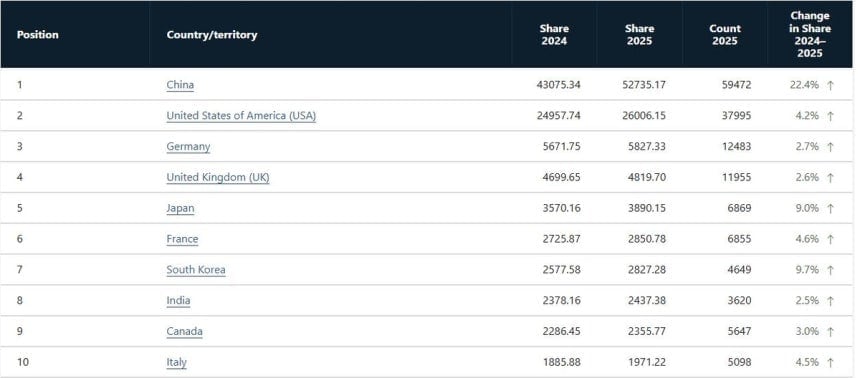
For the third straight year, China has topped the "Nature Index," which measures worldwide scientific research performance. South Korea stayed at 7th position, consistent with the previous year's placement.

The global academic publishing house Springer Nature, which publishes the journal *Nature*, revealed the list of "2026 Nature Index Research Leaders" on the 10th.

The Nature Index is a ranking system developed by Springer Nature that assesses the quantity of research articles published in prestigious scholarly journals, including those focused on natural sciences, along with their influence.

Although the Nature Index mainly focused on fundamental science and medicine disciplines, this year it broadened its coverage by adding 17 applied science journals and 15 social science journals.

China remained the leading nation for global research production this year. Its output rose by 22.4% between 2024 and 2025.

The United States came in second place, with Germany, the United Kingdom, Japan, France, South Korea, India, Canada, and Italy following closely behind.

Among the leading countries, China was the sole nation to achieve growth surpassing 10%. Japan and South Korea also experienced research output increases within the 9% bracket, reflecting strong expansion trends across Eastern Asia.

South Korea placed third in applied sciences, achieving a 14% increase in research production within this area, reflecting significant progress. Nevertheless, it came in eighth for natural sciences, highlighting that it continues to trail somewhat in fundamental scientific disciplines.

In terms of institutions, the Chinese Academy of Sciences was ranked number one. For the first time since the rankings started in 2015, Harvard University from the United States dropped from the top position to be replaced by Zhejiang University from China.

Apart from Harvard University, all entities ranked from 1st to 12th were Chinese institutes or universities. The German Max Planck Society dropped to 13th position, exiting the top 10.

At Seoul National University in South Korea, the institution secured the 58th position, moving down six positions compared to the previous year. Meanwhile, KAIST climbed two ranks to reach 80th spot.

Wednesday, June 17, 2026

Mystery Platform: China Claims Research at Scarborough Shoal

An announcement follows as Manila submitted an official complaint regarding the "unlawful presence" of a floating facility at the contested reef.

China stated that it conducted a scientific mission at Scarborough Shoal, as tensions with the Philippines escalate over the contested area. South China Sea atoll.

A research expedition that started on May 20 included the deployment of a mobile platform for ecological surveillance and data collection, according to a release from the South China Sea Institute of Oceanology under the Chinese Academy of Sciences issued on Wednesday.

It followed when Manila filed a formal diplomatic protest On Tuesday, regarding what it referred to as the "unlawful occupation" of a floating facility in Scarborough Shoal.

Are you curious about the major issues and developments happening globally? Find your answers here with SCMP Knowledge Our latest platform featuring carefully selected content, including explanations, frequently asked questions, analysis, and visual graphics, presented by our acclaimed team.

The National Task Force for the West Philippine Sea—an intergovernmental group responsible for managing Manila’s naval approach in the South China Sea—reported that air surveillance over the reef has identified a buoyant structure resembling an antenna.

The Chinese Foreign Ministry stated that it was properly using its rights to conduct actions such as "scientific research" at Scarborough Shoal and called on the Philippines to cease its "exaggerated publicity."

The research center stated that its voyage had explored all parts of the reef with the objective of gathering information about the geological development and biological reactions of coral reefs to changing environments.

Located approximately 124 nautical miles (230 kilometers or 143 miles) from the shores of the Philippines, Scarborough Shoal is a triangular coral reef encircling a lagoon. In China, it is referred to as Huangyan Island, while in the Philippines, it is called Panatag Shoal.

The group has emerged as a key point of contention in the ongoing conflict between the two countries above the South China Sea.

Last September, Beijing declared the creation of a natural sanctuary near the reef , sparking discussion about China's attempts to establish long-term structures there.

A Philippine Coast Guard spokesperson named Jay Tarriela informed journalists on Wednesday that their maritime surveillance mission conducted on May 30 was confronted by a Chinese People's Liberation Army aircraft.

He further mentioned that no excavation ships—employed for constructing man-made islands—were present in the region.

"I'm certain we still haven't figured out what they're up to," Tarriela remarked.

However, I prefer to think that the reason for the Chinese research ships being there is because they have a base.

More Articles from SCMP

'Nothing at All': Why Hong Kong Residents Should Steer Clear of Shared Indifference

Top attractions in Wuxi, China's scenic lakefront city known for its beautiful gardens and delicious food

Chinese artificial intelligence technology for law enforcement focuses on physical, mental, and emotional conditions

Hong Kong technology park bid requires robust applicants to provide a HK$100 million deposit

The article was first published on the South China Morning Post (www.scmp.com), a top-tier news outlet covering developments in China and Asia.

© 2026. South China Morning Post Publishers Ltd. All rights reserved.

Friday, June 12, 2026

Japan Unveils H3 Rocket: First All-Liquid-Fuel Launch

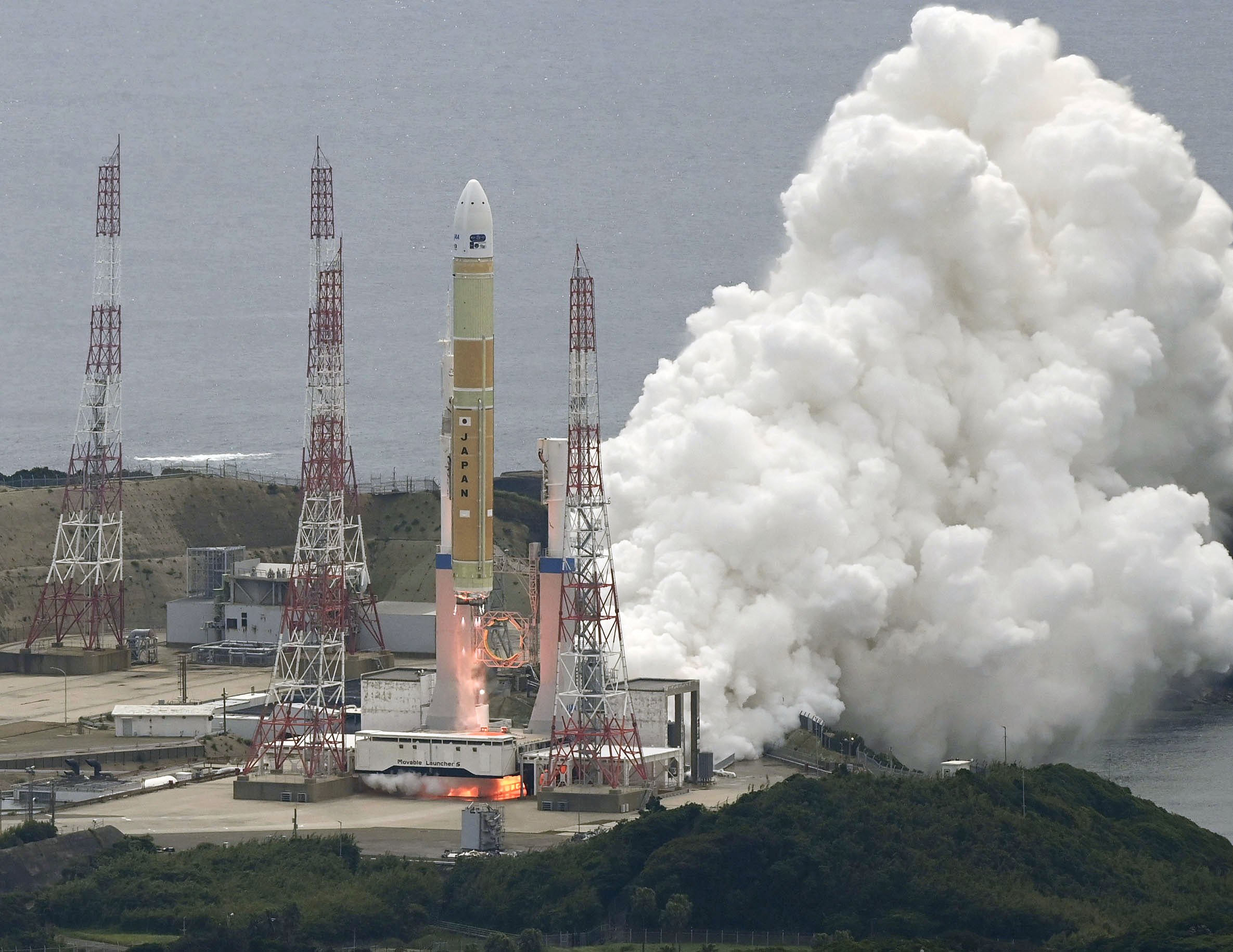
TOKYO - Japan successfully carried out a launch of an H3 rocket The Japan Aerospace Exploration Agency reported from the Tanegashima Space Center in southern Japan that small satellites were placed into orbit on Friday during the nation's initial rocket launch utilizing only liquid-fueled engines.

Rocket H3 Number 6 took off from the facility in Kagoshima Prefecture approximately at 9:55 a.m., delayed by two days compared to the original schedule because of poor weather conditions at the launching location.

The rocket features an innovative, more straightforward design consisting of three primary engines without solid rocket boosters. According to JAXA, this version weighs less and costs fewer compared to other H3 models, and its successful launch finalizes the range of three H3 configurations.

The spacecraft transported six mini-satellites, among them the Umitsubame from the Institute of Science Tokyo, which will employ an advanced camera to monitor oceanic areas, and the Shiraito from Shizuoka University, designed to evaluate methods for eliminating orbital waste.

The most recent failed attempt to launch an H3 rocket in December unable to launch a satellite to space. The rocket's first launch in March 2023 concluded with a self-destruct order because the second-stage engine failed to start.

H3 Rocket Number 6's debut faced a postponement following an issue discovered during an engine firing test in July.