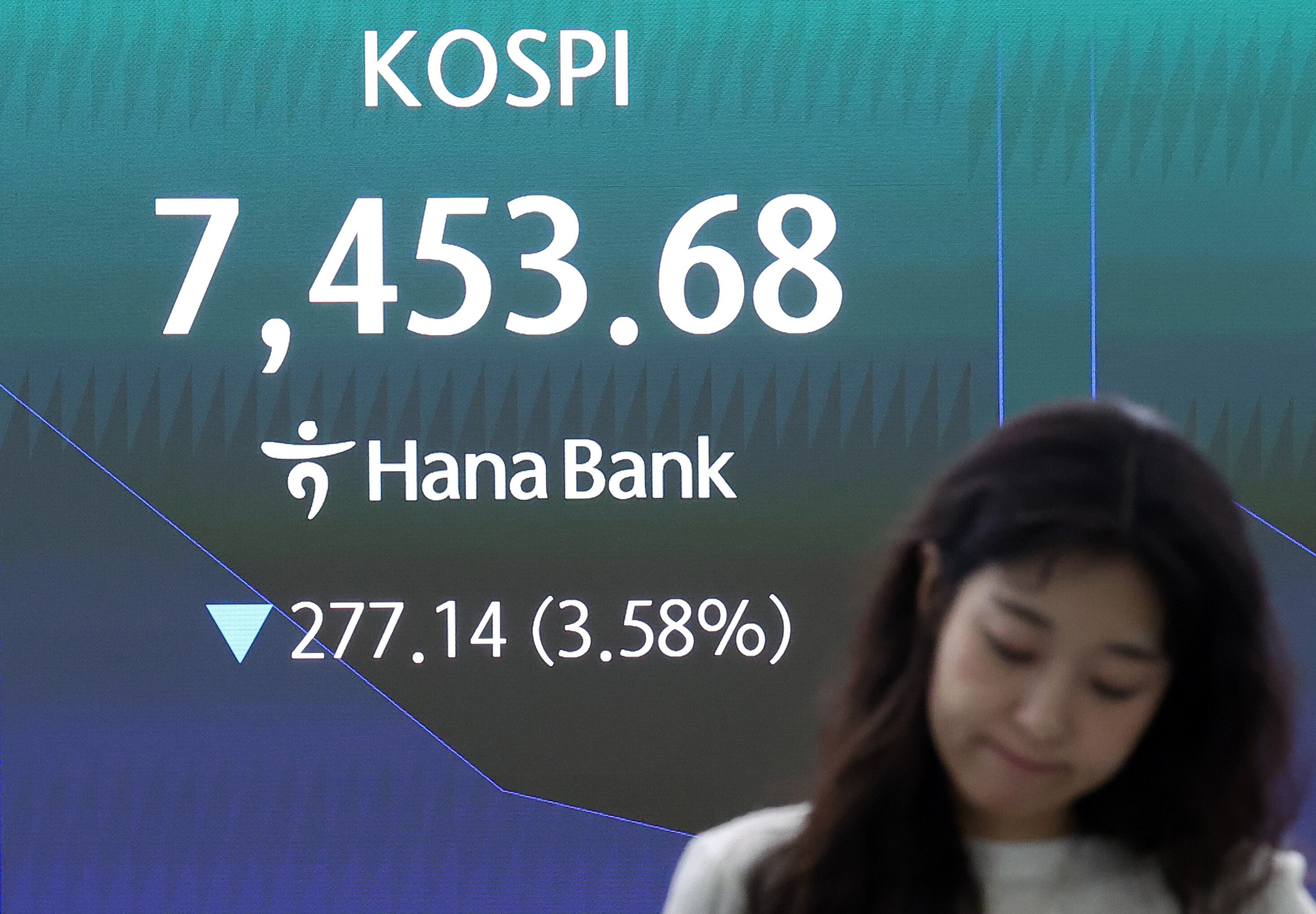
The South Korean stock market declined by about 1.5% on the 11th due to twin pressures from U.S.-induced inflationary trends and worries regarding the financial viability of the artificial intelligence sector.
On the same day, the KOSPI index remained around the 7,616 mark, declining by 108 points (1.4%) compared to the last trading day. Having exceeded 7,730 the previous day, the index fell sharply into the middle of the 7,400s within one session, temporarily crossing below the 7,400 level, reaching a low of 7,394.46.
Many individual stocks also experienced declines. Samsung Electronics, a key indicator in the semiconductor sector, dropped 4,000 South Korean won (1.4%) to 298,000 won from the prior day, falling under the 300,000-won threshold. Hyundai Motor was trading at 584,000 won, declining roughly 3%, whereas LG Electronics decreased by about 3.3% to 216,500 won.
Significantly, Doosan Enerbility, which had gained due to hopes for nuclear power plants, dropped 5.71% (5,200 won) to 85,900 won, recording the biggest fall among major stocks. Samsung Electro-Mechanics also declined, slipping 2.6% to 1,759,000 won. In contrast, SK Hynix increased approximately 2% to reach 2,080,000 won.
The downward trend of the day was driven by the significant fall in U.S. financial markets from the prior day. The Nasdaq Composite Index dropped 1.98%, while the S&P 500 Index declined by 1.62%, causing a halt in worldwide investor confidence.
Financial institutions viewed the scenario not simply as temporary fluctuations but as an indication of deeper structural issues, with both broader economic factors and company performance experiencing instability at the same time. DS Investment & Securities noted, "This drop is hard to ignore as a quick recovery," further stating, "The market is moving into a long-lasting correction period due to declining wage growth and concerns over AI's financial returns."
What specifically caused the market to freeze was worry about "stagnant consumption" and the "AI bubble hypothesis." DS Investment & Securities noted, "Rising oil prices are increasing the Consumer Price Index (CPI), undermining the U.S. Federal Reserve's justification for lowering interest rates, as real hourly earnings in the United States have shown negative numbers for three straight months, putting significant pressure on consumer spending."
Moreover, uncertainty surrounding the financial performance of AI-focused stocks, which were previously highly favored by investors, came into view. After Broadcom, Oracle also fell short of investor forecasts in its primary software operations, raising deeper questions about whether "AI can genuinely create revenue."


No comments:
Post a Comment