I’m Lee Hyun-moo, founder of IU Global. This is a story of a unicorn that once generated $500 million in revenue but faced collapse. Can a heavyweight unicorn rebound after a downward spiral? Reality isn’t a drama. Heavyweights don’t easily bounce back with pivots.
Today’s interview is with Lee Hyun-moo, founder of IU Global (hereafter IU Global). Honestly, he gave off the vibe of a “cold-blooded businessman” who chooses people based on “pros and cons.” Yet, the *CJAM* reporters found him likable. His skills as a CEO—perhaps the most founder-like among startup founders—deserve respect.
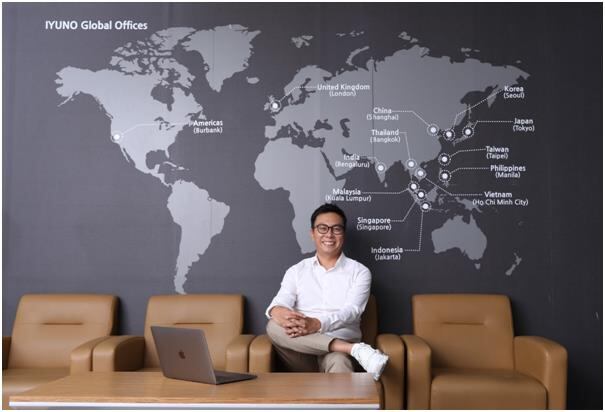
IU Global is the world’s top media localization company. We provide dubbing, subtitling, and technical services for streaming platforms until content is finalized. Our market share is double that of the second-place competitor. We’re the only company directly owning and operating dubbing studios across Asia, Europe, and the Americas. With 300 recording rooms in 31 countries, 20,000 translators, 20,000 voice actors, and services in over 100 languages, we lead the industry.
At our peak, revenue hit $511 million. Then, the Hollywood strike and a security breach occurred. Lee Hyun-moo said, “Even I thought there was a 90% chance we’d collapse.” This year’s revenue is projected at $320–50 million. We’ve survived.
Is a dubbing and subtitling company needed in the AI era? The revenue drop stemmed from the belief that AI would replace IU Global’s business. Yet, after hitting rock bottom, we bet on AI. For example, we created an AI named Chloe. Chloe “watches” content like a human and stores it in a database. Lee said, “Innovation happens when you’re broke, at the bottom.” In 2002, three university students started a translation company with 6 million Korean won in cash advances. How did IU Global become number one, collapse, and rise again? Lee answers.
◇ From $6 Million Korean Won Startup to $500 Million Revenue: A Crazy Success Story, But…
= IU Global is a translation, subtitling, and dubbing company, right?
“We’re the world’s top media localization company. It’s not just dubbing and subtitling. We handle end-to-end services: editing, encoding, packaging, and distribution pipelines until content reaches platforms like Netflix. Our market share is roughly double that of the second-place competitor.
We’re the only company with dubbing studios in Asia, Europe, and the Americas. Competitors either lack studios or outsource. Our clients are major global streamers, OTTs, studios, and broadcasters—names everyone would recognize.”
“Revenue breakdown: 70% dubbing, 25% subtitling, 5% media services. We have around 300 recording rooms in 31 countries and work with 20,000 translators and 20,000 voice actors annually. Internal staff range from 1,900 to 2,000—project managers, engineers, and directors.”
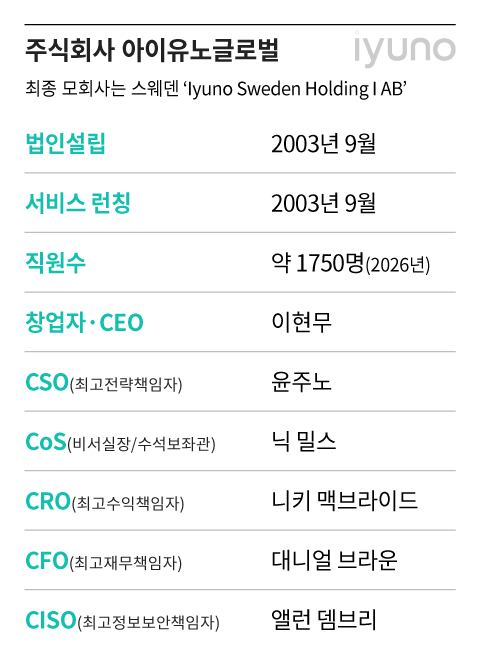
= In 2022, revenue was $511 million. It surged post-2018.
“Peak revenue was $511 million, but it dropped. This year, we expect around $320 million. The first half exceeded expectations, and the full year might reach $340–50 million. We’ve recovered significantly.”
“The decline began with the 2022 Hollywood writers’ and actors’ strike. A major client cut spending, and a security breach in 2023 worsened things. We free-fell for two years. Clients left.”
“It was tough. Shareholders trusted us, and we secured internal funding multiple times. We cut costs drastically, including layoffs. However, we invested heavily in security to regain trust and are rebounding in 2026 as major clients return.”
= Rebounding from rock bottom is rare for startups. Most collapse.
“True. The collapse probability was over 90%. It was a grueling period. Positively, the crisis unified us. IU Global was formed by merging three companies, each with its own culture and factions. But when survival is at stake, everyone becomes one team—like Earthlings uniting against aliens. Cultural integration, which takes decades for big companies, happened instantly. There was no time to fight over pie.”
= That’s overly optimistic. Many fail to persuade employees.
“A week after the security breach, after crisis management, we held an all-hands meeting. We said, ‘We’re in deep trouble. This isn’t easy, but if we follow our plan, we can recover.’ Clarity and hope were key.”
◇ “Innovation Happens When You’re Broke”
= The drop wasn’t just about security. There was a prevailing belief that AI would replace subtitling, making IU Global obsolete. Where was the hope?
“AI wasn’t scary then (2022–23) because it couldn’t deliver. Can AI create Netflix-level subtitles for a drama? No.”
= But the narrative was that AI would eventually replace the industry.
“Entrepreneurs draw lines—‘AI won’t do this’—but technology keeps crossing them. Would subtitling vanish? Or could we lead the change? The security breach forced a decision. Previously, we defended against ‘someday’; now, AI became a must-win battle. Revenue was falling, costs were cut to the bone, and without a vision, no one would invest. Desperation drove us to innovate.”
“Funny—we had a similar experience in 2002. We developed a translation software called MediaTrans, patented it, and sold it to CJ. It handled 90% of Korea’s foreign film subtitles. But an executive poached clients and employees, leaving me and one staff member. Revenue dropped from 20 million to 2 million Korean won. To survive, we automated—hence MediaTrans. AI was the same.”
“We invested in AI but saw no results. The conclusion was, ‘AI can’t replace subtitling.’ But crisis changed that. Innovation arises from desperation. When broke, employees work tirelessly without pay.”
= You created Team X during the crisis.
“Two reasons: First, large companies prioritize stability over innovation. Our ‘Security First’ culture blocks risky projects. So, we needed a separate startup-like team under the CEO—Team X, with 20 engineers and operators. Now, it’s a core team.”
“Second, we needed a vision. Five years ago, we co-invested in an AI translation startup. We concluded, ‘Translation can’t be replaced.’ For example, how does AI handle honorifics? Without context—like whether speakers are siblings or strangers—it fails. Back then, we used this to defend against AI. Now, we had to prove it.”
= Your first experiment was English honorifics.
“Simple: Six team members sat in a room. We input, ‘A is 40, B is his 10-year-old daughter,’ then ‘Hey, how are you doing?’ The AI translated it as ‘How are you?’—not ‘How are you, mother?’ Team members said, ‘It doesn’t work.’ But in the LLM era, we tried again with ChatGPT—it worked. Reversing the input switched between formal and informal. That was the breakthrough.”
“We realized the issue wasn’t the model but context. Old models lacked ‘ears’ to listen; LLMs do. If honorifics work, other nuances—gender, age, sarcasm—will too. We expanded experiments and built Chloe.”
◇ Chloe: AI That Replicates Human ‘Watching Experience’

= Define Chloe.
“The problem: Translators, subtitlers, and creators redundantly watch content. They interpret it differently, creating security risks. Chloe uses AI agents to ‘watch’ content like humans. She factors in scripts, previous episodes, brand rules (e.g., ‘No pork mentions in Malaysia’), and generates a database.”
“She tracks characters’ locations, relationships, and emotions. Unlike humans, she shares this memory. From there, AI skills generate subtitles, SDH (Subtitles for the Deaf and Hard of Hearing), audio descriptions, marketing copy, metadata, etc.”
= How is she trained?
“Chloe isn’t a single model. She uses agents to process content. For example, Gemini analyzes video but can’t build memory due to context window limits. Chloe, however, tracks entire seasons. She infers that a character in one scene is the same as in another, even if their appearance or voice changes. She maps apartment layouts—if a character enters a room, she knows they’re inside. These human-like inferences are agent-based. We call it ‘mimicking human watching.’”
“Demo: In a scene where a character speaks to no one, Chloe infers the listener. She describes settings: ‘Elle visits a doctor; a cabinet is on the counter; her emotion is tense.’ She deduces, ‘Elle is pregnant with someone’s baby.’ If a phone shows a kidnapping news article, Chloe translates it. Brand logos are ignored. Human-like tracking is complex—processing a one-hour file takes three hours.”
= Chloe creates subtitles using her ‘content memory’?
“Skills extract outputs. Subtitles, SDH, audio descriptions, synopses, YouTube tags—all derive from her memory. For SDH, she adds ‘tense music plays’ because she knows the soundtrack. Clients build one ‘content memory’ and generate unlimited outputs. Previously, subtitling 20 languages was expensive; now, 100 languages cost only AI tokens.”
= Is Chloe based on Gemini?
“Yes. We use Gemini and enterprise-licensed models. We don’t manage servers—costs are high, but we need top multimodal performance. Internally, we’re eliminating translation layers with ‘Sub X.’ Currently, 10% of workloads use Chloe; by year-end, 70% will. Chloe launches as a SaaS platform in September. Pricing is high due to token costs but far cheaper than human labor.”
“This helped revenue recovery. Clients initially avoided us post-breach but returned, seeing AI partnership value. Our security investments made us a trusted leader.”
◇ The Paradox: AI Dubbing Takes Longer Than Human Dubbing

= Isn’t AI dubbing automatic?
“AI dubbing replaces voice actors but requires creative direction. For a thousand lines, directors specify tone: ‘Read this line strongly, whisper this one.’ AI needs iterative prompting—30–100 times. Human dubbing takes 21 calendar days; AI dubbing takes 24 business days—two weeks longer.”
= YouTube AI dubs lack emotional tone.
“They lack immersion. Paid content needs engagement, so short-form dramas prefer human dubbing.”
= Does Chloe change this?
“AI dubbing’s iteration problem stems from context. Directors manually prompt each line. Chloe automates this. Since she ‘watched’ the entire content, she generates line-by-line prompts. For example, ‘Hello’ becomes, ‘Say this while descending a mountain, given the character’s backstory.’ Humans can’t scale this. Chloe does it automatically—faster, cheaper, and emotionally accurate.”
◇ Conversations with Characters, Not Actors: Chloe’s Content Memory
= What else can Chloe do?
“Subtitles, dubbing prompts, SDH, audio descriptions, synopses, YouTube metadata, press releases, and chatbots. We built a chatbot using content memory. Traditional chatbots lack universe context, but Chloe’s memory enables IP-based bots. For example, chat with *Squid Game* characters. Text-based now, but holograms and physical AI may follow.”

“Chatbot users are teens to early 20s. To attract older audiences, major IPs are key. Context is crucial. Falsehoods become lies only with context. Universe chatbots can avoid this. We’re discussing content memory archives with the Korean government.”
= Can Chloe create content?
“Yes. Extracting context from content, we could generate webtoons or videos from novels. Current Gen Video is limited to 15 seconds with inconsistent faces. Chloe could reverse-engineer this: build content memory from a novel, then create visuals. Consistency—like a remote control staying in the same spot—is key. Without it, production fails. Chloe could solve this.”
◇ $6 Million Korean Won, VHS Tapes, and $1 Billion Debt
= Why a translation company in 2002?
“I failed freshman year, took extra semesters, and translated part-time. My boss offered a job, and I met two partners—a translator and a salesperson. We planned to run it for nine months before studying abroad. Each took 2 million Korean won in cash advances. Deposit: 5 million; desk: 1 million. The partnership dissolved after a year—revenue was too low.”
= The early days were toughest, with $1 billion debt.

“Revenue came in slowly, expenses faster. No accounting knowledge—borrowed from family, KOTEC. The worst: missing a client’s mother-in-law’s funeral, losing half our revenue. I decided to move to Singapore.”
= Why Singapore?
“Korea only needed single-language services. Singapore offered multilingual opportunities. I moved with nothing. For a year, no contracts. Then, a client needed Korean content for a Hallyu channel. I built a low-cost file-transfer system—computers in Seoul and Singapore. I drove hard drives to clients for three years, saying, ‘We’ll handle translation and dubbing if you use our system.’ We later built studios, commuting weekly from Singapore to Kuala Lumpur. This made us Asia’s strongest player.”
= How did you break into the U.S. and Netflix?
“After expanding to five countries, Netflix was booming. A salesperson couldn’t attend a meeting due to tinnitus, so I went instead—it connected us to Netflix. They needed Asian vendors for 190 countries. We secured the contract, and revenue exploded—100% annual growth for three years. We expanded to 10+ countries, and our MediaTrans tech improved. Netflix awarded us twice as a top vendor. We were unstoppable.”
= SoftBank investment and M&A made you number one.
“After dominating Asia, we targeted Europe. But expanding would take decades. Japan was tough—culturally sensitive. Investors suggested going public or bolt-on acquisitions. Our multiple was high; acquiring a company at half our multiple created arbitrage.
“First investment was SoftBank Ventures Asia (SBVA) in 2018: $25 million at a $100 million valuation, 25% stake. By 2018, revenue was $70–80 million, profit $20 million. We merged with BTI—a larger but indebted company—at equal valuation.
“In 2021, we acquired SDI, our only global competitor. SoftBank’s Vision Fund raised $200 million at a $600–700 million valuation, funding the acquisition.”
= Merging competitors made you the only global player.
“Yes. Our motto was ‘Be the one and only.’ Post-merger, management integrated well, setting record profits. Then came the strike, breach, and crash. We’re climbing back.”
※ *CJAM*’s note: This interview isn’t the end. IU Global’s survival isn’t confirmed. If AI dubbing, subtitling, and ‘human-like content-watching AI’ prove viable, Lee’s vision could surpass $10 billion. The challenge? Tech evolves daily, and competitors may rise unnoticed. If Lee agrees, we’ll revisit IU Global’s survival in one or two years.


No comments:
Post a Comment